
2025-10-21 ノースカロライナ州立大学(NCState)
<関連情報>
- https://news.ncsu.edu/2025/10/increasing-heat-is-super-charging-arctic-climate-and-weather-extremes/
- https://www.nature.com/articles/s43017-025-00724-4
変化する北極の気象と気候の極端 Weather and climate extremes in a changing Arctic
Xiangdong Zhang,Timo Vihma,Annette Rinke,G. W. K. Moore,Han Tang,Cecilia Äijälä,Alice DuVivier,Jianbin Huang,Laura Landrum,Chao Li,Jing Zhang,Linette Boisvert,Bin Cheng,Judah Cohen,Dörthe Handorf,Edward Hanna,Katharina Hartmuth,Marius O. Jonassen,Yong Luo,Sonja Murto,James E. Overland,Chelsea Parker,William Perrie,Kirstin Schulz,… Minghong Zhang
Nature Reviews Earth & Environment Published:21 October 2025
DOI:https://doi.org/10.1038/s43017-025-00724-4
Abstract
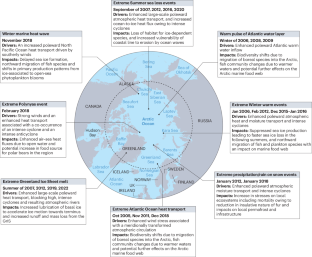
Weather and climate extremes are increasingly occurring in the Arctic. In this Review, we evaluate historical and projected changes in rare Arctic extremes across the atmosphere, cryosphere and ocean and elucidate their driving mechanisms. Clear shifts occur in mean and extreme distributions after ~2000. For instance, pre-2000 to post-2000 observational probabilities of 1.5 standard deviation events increase by 20% for atmospheric heat waves, 76.7% for Atlantic layer warm events, 83.5% for Arctic sea ice loss and 62.9% for Greenland Ice Sheet melt extent — in many cases, low probability, rare extreme events in the early period become the norm in the latter period. These observed changes can be explained using a ‘pushing and triggering’ concept, representing interplay between external forcing and internal variability: long-term warming destabilizes the climate system and ‘pushes’ it to a new state, allowing subsequent variability associated with large-scale atmosphere–ocean–ice interactions and synoptic systems to ‘trigger’ extreme events over different timescales. Ongoing anthropogenic warming is expected to further increase the frequency and magnitude of extremes, such that simulated probabilities of 1.5 standard deviation events increase by 72.6% for atmospheric heat waves, 68.7% for Atlantic layer warm events and 93.3% for Greenland Ice Sheet melt rate between historic (1984–2014) and future (2069–2099) periods under a very high emission scenario. Future research should prioritize the development of physically based metrics, enhance high-resolution observation and modelling capabilities and improve understanding of multiscale Arctic climate drivers.


