2025-10-17 中国科学院(CAS)
<関連情報>
- https://english.cas.cn/newsroom/cas_media/202510/t20251017_1089586.shtml
- https://www.nature.com/articles/s41561-025-01784-3
暁新世・始新世温暖化極大期における好気性メタン酸化によって増幅された北極のCO2排出量 Arctic CO2 emissions amplified by aerobic methane oxidation during the Palaeocene–Eocene Thermal Maximum
Bumsoo Kim,Yi Ge Zhang,Richard E. Zeebe & Jiaheng Shen
Nature Geoscience Published:25 September 2025
DOI:https://doi.org/10.1038/s41561-025-01784-3
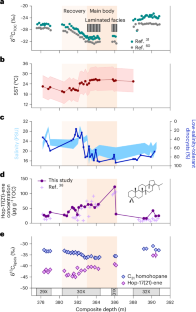
Abstract
In the Arctic Ocean, polar amplification drives warming rates that are two to three times the global average, and this enhanced warming and the associated freshening are expected to accelerate methane cycling, impacting regional and global carbon cycling. However, our understanding of methane cycling in a warmer and fresher Arctic is limited by short observational records. Here we present biomarker evidence for prevalent aerobic methanotrophy in the Arctic Ocean during the Palaeocene–Eocene Thermal Maximum (PETM; ~56 million years ago), identified through the occurrence of a hopanoid compound, hop-17(21)-ene, with a distinct isotopic signature characteristic of bacterial methanotrophy. During the PETM, intensified hydrological cycling atop an overall low-sulfate ocean of the early Cenozoic limited sedimentary sulfate availability, suppressing sulfate-dependent anaerobic methane oxidation and facilitating aerobic methane oxidation in the water column, consistent with our geological evidence and sediment diagenesis model results. Unlike anaerobic oxidation, which generates alkalinity, aerobic methane oxidation consumes oxygen and produces CO2. Our biomarker-based CO2 reconstructions indicate that the Arctic Ocean became a net CO2 source, particularly during the recovery stage, contributing to prolonged carbon input, temperature rise and ocean acidification during the PETM. These findings highlight potential major perturbations to Arctic carbon cycling under future climate change.