
2025-10-17 エディンバラ大学
<関連情報>
- https://www.ed.ac.uk/news/tropical-rainforest-shifts-from-carbon-sink-to-source
- https://www.nature.com/articles/s41586-025-09497-8
オーストラリアの熱帯林の地上バイオマスは今や純炭素源となっている Aboveground biomass in Australian tropical forests now a net carbon source
Hannah Carle,David Bauman,Michael N. Evans,Ingrid Coughlin,Oliver Binks,Andrew Ford,Matthew Bradford,Adrienne Nicotra,Helen Murphy & Patrick Meir
Nature Published:15 October 2025
DOIhttps://doi.org/10.1038/s41586-025-09497-8
Abstract
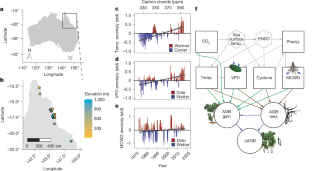
Tropical forests act as important global carbon sinks1, and Earth System Models predict increasing near-term carbon sink capacity for these forests, with elevated atmospheric carbon dioxide concentration thought to stimulate tree growth2,3. However, current forest inventory data analyses suggest that the carbon sink capacity of intact tropical forests may be in decline, portending a possible future switch from carbon sinks to carbon sources3,4,5,6,7. Here we use long-term forest inventory data (1971–2019) from Australian moist tropical forests and a causal inference framework8,9,10 to assess the carbon balance of woody aboveground standing biomass over time, the demographic processes accounting for it, and its climatic drivers, including cyclones. We find that a transition from sink (0.62 ± 0.04 Mg C ha−1 yr−1: 1971–2000) to source (−0.93 ± 0.11 Mg C ha−1 yr−1: 2010–2019) has occurred for the aboveground woody biomass of these forests, with sink capacity declining at a rate of 0.041 ± 0.032 Mg C ha−1 yr−1. The transition was driven by increasingly extreme temperature and other climate anomalies, which have increased tree mortality and associated biomass losses4, with no evidence of the carbon fertilization (stimulation) of woody tree growth. Forest dynamics underlying carbon sink capacity were also punctuated by cyclones, with impacts of a similar magnitude to long-term climate-induced changes. Our findings suggest the potential for a similar response to climate change by woody aboveground biomass in moist tropical forests globally, which could culminate in a long-term switch from carbon sinks to carbon sources.


