2025-10-16 韓国基礎科学研究院(IBS)
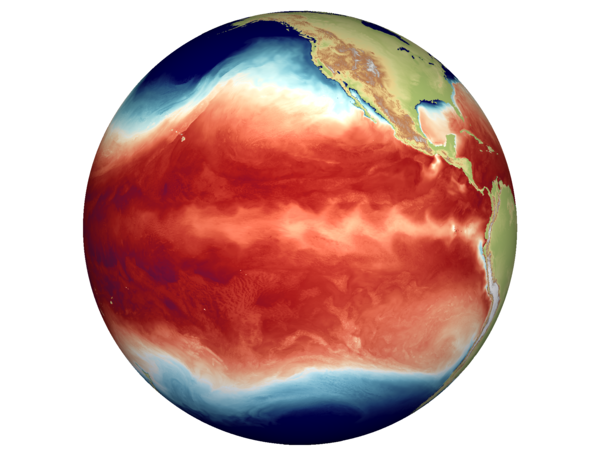
Figure 1. Snapshot of eastern Pacific sea surface temperatures, showing temperature pattern for a typical La Niña event with equatorial cold temperatures and wave-like structure west of the Galapagos Islands simulated by a high-resolution climate model. Blue to red color shading indicates a transition from colder to warmer surface conditions. The amplitude of La Niña and El Niño conditions can intensify in response to global warming, and the succession of these extremes will also become more regular.
<関連情報>
- https://www.ibs.re.kr/cop/bbs/BBSMSTR_000000000738/selectBoardArticle.do?nttId=26187
- https://www.nature.com/articles/s41467-025-64619-0
急速に激化するエルニーニョ・南方振動による地球規模の気候モード共鳴 Global climate mode resonance due to rapidly intensifying El Niño-Southern Oscillation
Malte F. Stuecker,Sen Zhao (赵森),Axel Timmermann,Rohit Ghosh,Tido Semmler,Sun-Seon Lee,Ja-Yeon Moon,Fei-Fei Jin & Thomas Jung
Nature Communications Published:16 October 2025
DOI:https://doi.org/10.1038/s41467-025-64619-0
Abstract
The El Niño-Southern Oscillation (ENSO) influences climate variability globally, encompassing various other modes of variability, and thus represents a key predictable climate signal on seasonal timescales. Yet, its response to greenhouse warming remains uncertain, with models projecting a range of outcomes. Here, we demonstrate that in response to warming, a state-of-the-art high-resolution climate model simulates a rapid transition from a moderate-amplitude irregular regime, as observed in the current climate, to a highly regular oscillation with intensifying amplitude. This behaviour can be attributed to increasing air-sea feedbacks, which approach criticality in the second half of this century, and growing atmospheric noise. As ENSO intensifies in this model, it synchronizes with other prominent climate modes, such as the North Atlantic Oscillation and the Indian Ocean Dipole, thereby imprinting its regular, predictable variability on them. If realized, this global climate mode resonance would have wide-ranging whiplash impacts on regional hydroclimates.