2025-10-15 マサチューセッツ工科大学(MIT)
<関連情報>
- https://news.mit.edu/2025/why-some-quantum-materials-stall-while-others-scale-1015
- https://www.sciencedirect.com/science/article/abs/pii/S1369702125004079
量子材料は経済的、環境的に持続可能でしょうか? Are quantum materials economically and environmentally sustainable?
Artittaya Boonkird, Mouyang Cheng, Abhijatmedhi Chotrattanapituk, Denisse Córdova Carrizales, Ryotaro Okabe, Nathan C. Drucker, Manasi Mandal, Thanh Nguyen, Jingjie Yeo, Vsevolod Belosevich, Ellan Spero, Christine Ortiz, Qiong Ma, Liang Fu, Tomas Palacios, Farnaz Niroui, Mingda Li
Materials Today Available online: 7 October 2025
DOI:https://doi.org/10.1016/j.mattod.2025.09.014

Abstract
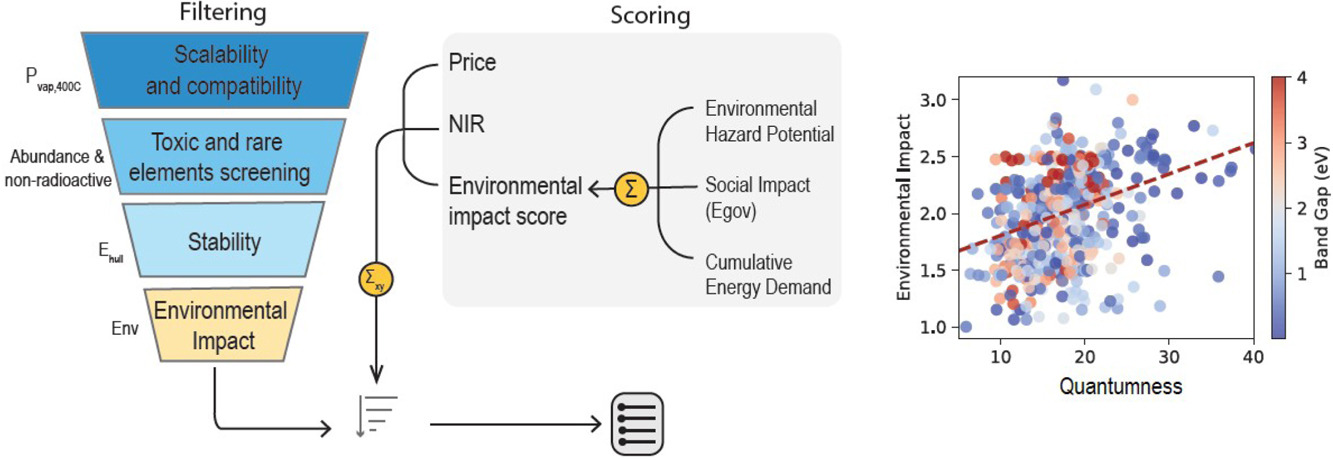
Quantum materials have revolutionized energy, information, and healthcare technologies, yet their development has largely prioritized performance over economic and environmental impacts—key factors for industrial adoption. Using topological materials as a case study, we present a data-driven framework that evaluates over 16,000 materials based on cost, supply chain resilience, energy demand, toxicity, and environmental footprint. By integrating the recently proposed quantum weight – a metric quantifying quantum behavior – we reveal a striking trend: materials with stronger quantum effects often exhibit higher environmental impact, posing challenges for scalability and industrial adoption. To address this, we identify a small set of materials that achieve a balance between quantum functionality and sustainability. Our approach enables high-throughput, AI-driven materials discovery that incorporates economic and environmental influences from the outset, guiding the development of quantum materials for next-generation microelectronics and energy harvesting technologies.