2025-10-13 中国科学院(CAS)
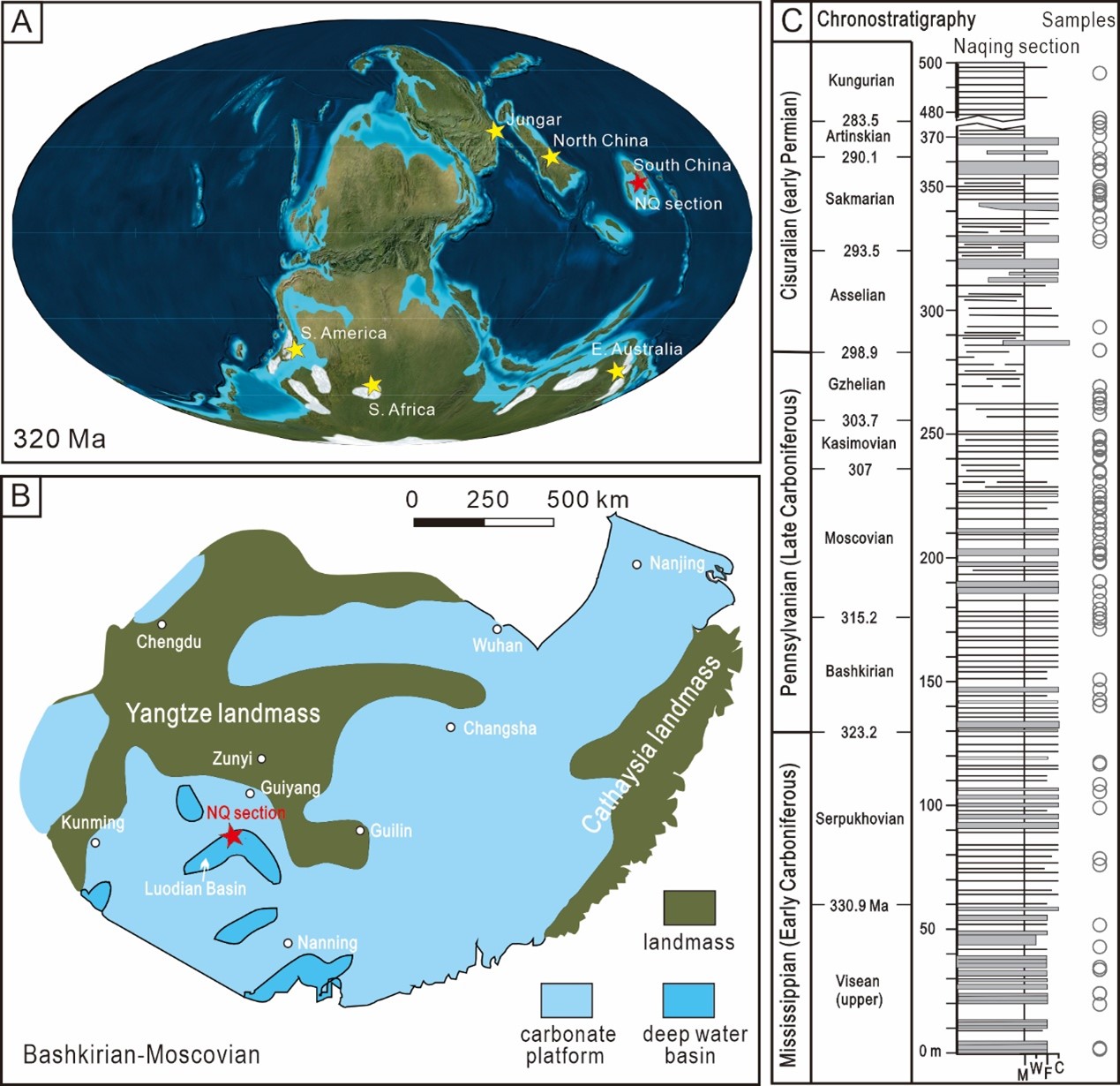
(a)Global paleogeographic framework of the late Carboniferous. (b)Lithofacies paleogeographic map of South China around the Bashkirian-Moscovian stage. (c)The lithological column of the Naqing section in South China and sampling records. (Image by NIGPAS)
<関連情報>
- https://english.cas.cn/newsroom/research_news/earth/202510/t20251013_1089310.shtml
- https://agupubs.onlinelibrary.wiley.com/doi/10.1029/2025GL117395
古生代後期氷河期における大陸の風化作用の解明 Disentangling Continental Weathering During the Late Paleozoic Ice Age
Biao Gao, Guozhen Xu, Wenli Yang, Jitao Chen
Geophysical Research Letters Published: 04 October 2025
DOI:https://doi.org/10.1029/2025GL117395
Abstract
The consumption of atmospheric CO2 through continental weathering played a critical role in shaping the evolution of the late Paleozoic Ice Age (LPIA), presumably driven by the Hercynian orogeny and the evolution of terrestrial plants. However, the relative impacts of these two major drivers to continental weathering remain poorly constrained. The South China Block was located near the paleo-equator under a relatively stable tectonic setting during the late Paleozoic, and therefore provides valuable insights into silicate weathering dynamics. Here, we report a 60-Myr-long record of the chemical index of alteration (CIA) from a continuously deposited slope succession in South China. By integrating existing records of weathering proxies, we concluded that the Hercynian orogeny played an overwhelming role in enhanced silicate weathering rates during 333–291 Ma, whereas paleotropical forest ecosystems demonstrated their significant influences on weathering patterns during their rapid expansion phase (333–316 Ma).
Plain Language Summary
Both the Hercynian orogeny and the evolution of terrestrial plant ecosystem exerted fundamental influences on the late Paleozoic climate dynamics by modulating atmospheric CO2 consumption through continental silicate weathering. A record of weathering intensity from a paleotropical continent with stable tectonic setting would provide new insights into regional versus global silicate weathering dynamics. South China represents an ideal area for such investigations given its stable tectonic setting and paleo-equator location during the Carboniferous-Early Permian. Here, we obtained a 60-Myr-long record of the chemical index of alteration from a continuously deposited slope succession in South China. A four-stage evolutionary trend in silicate weathering has been recognized in South China during the 333–275 Ma interval. By integrating the existing seawater Li and Sr isotopes, we concluded that the Hercynian orogeny played the dominant role in enhancement of global continental weathering during 333–291 Ma, whereas paleotropical forest expansion assisted this tectonic driver in influencing the weathering dynamics during 333–316 Ma. Although silicate weathering intensity increased during 291–275 Ma, integrated analyses indicate that continental silicate weathering likely experienced net global-scale suppression due to the combined effects of Hercynian orogenic collapse and intensifying aridification, thereby driving Earth’s climate toward a warming trajectory.
Key Points
- The chemical weathering intensity of South China exhibits a four-stage evolutionary trend during 333–275 Ma
- The Hercynian orogenic uplift played a dominant role in the enhanced continental silicate weathering during 333–291 Ma
- The significant influence of paleotropical forest expansion on weathering dynamics was sufficiently shown during 333–316 Ma in South China