
2025-10-13 ペンシルベニア州立大学(PennState)
<関連情報>
- https://www.psu.edu/news/research/story/earths-continents-stabilized-due-furnace-heat-study-reveals
- https://www.nature.com/articles/s41561-025-01820-2
安定した大陸の超高温起源 Ultra-hot origins of stable continents
Andrew J. Smye & Peter B. Kelemen
Nature Geoscience Published:13 October 2025
DOI:https://doi.org/10.1038/s41561-025-01820-2
Abstract
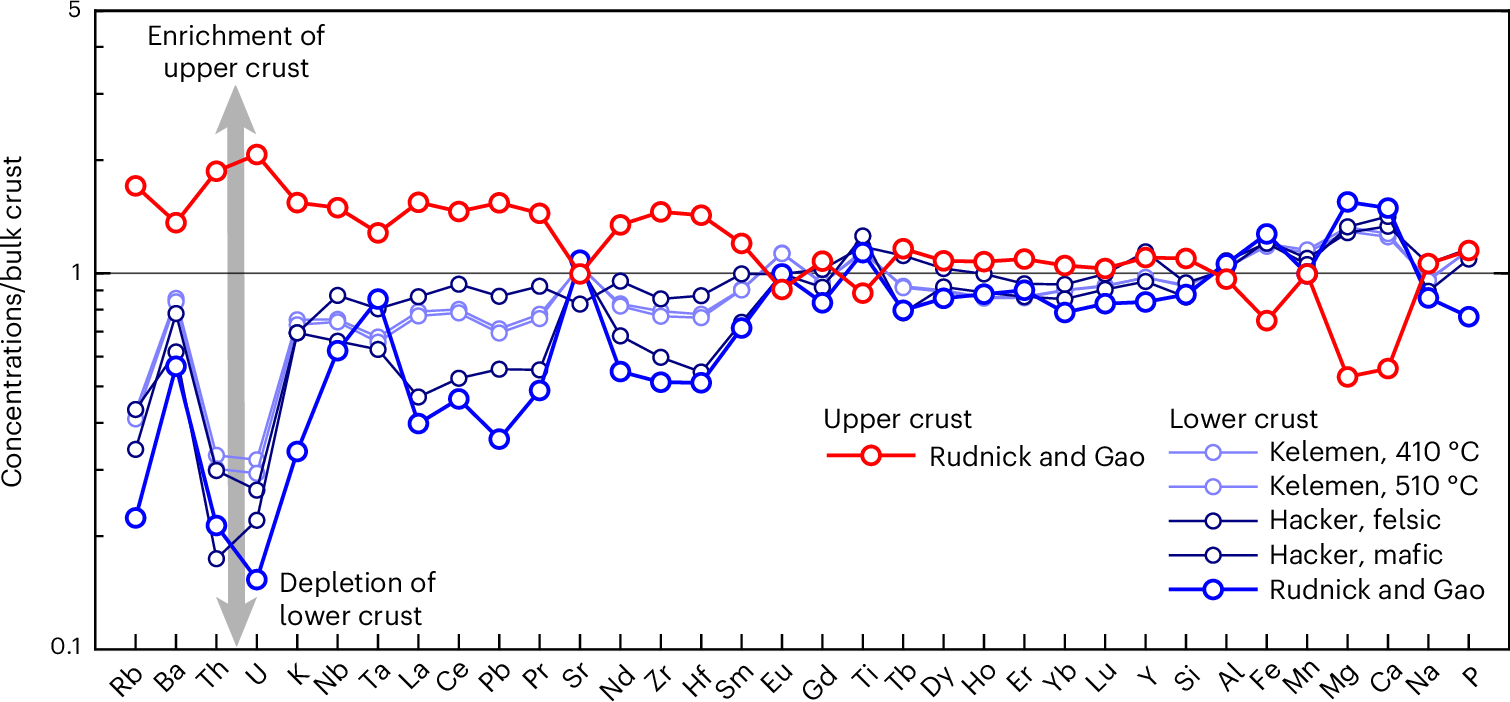
The origin and composition of Earth’s silica-rich continental crust, particularly the lower crust, remain uncertain. Stable continental crust, including cratons and crust older than 200 million years, is marked by enrichment of radiogenic heat-producing elements (U, Th and K) in the upper crust and depletion in the lower crust. Because the lower crust probably consists of >50% aluminous metasedimentary and evolved metaigneous rocks—both initially enriched in U and Th—continental differentiation requires a mechanism to transfer these elements upwards. Here, in our analysis of partially melted metasedimentary and metaigneous rocks, we show that ultrahigh temperatures (>900 °C) are essential to stratify heat production and stabilize crust. Removal of small fractions of ultrahigh-temperature melt generated by fluid-absent melting can produce the observed lower-crustal depletions in U and Th. By contrast, lower-temperature melting fails to drive differentiation owing to the resilience of monazite to dissolution in granitic melts. Our findings establish ultrahigh-temperature melting as an important criterion for the formation of stable continents, providing a direct link between the formation of cratons and ultrahigh-temperature metamorphic terrains and the supercontinent cycle. This insight constrains the tectonic settings responsible for crustal differentiation.

