2025-10-10 中国科学院(CAS)
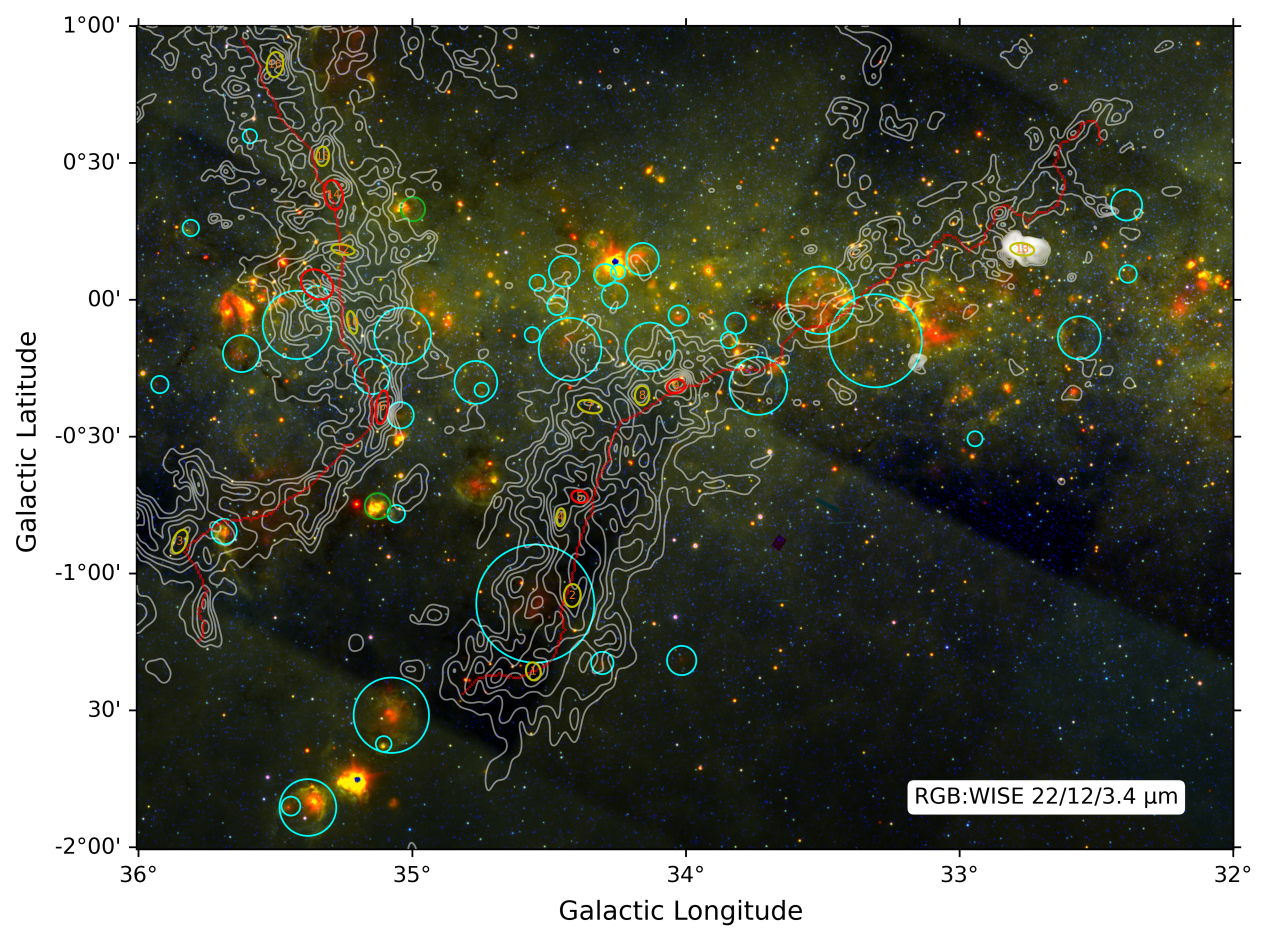 G34 molecular cloud. Three-color composite image of WISE 3.4 (blue), 12 (green), and 22 µm(red) bands (background). The white contours represent the integrated intensity of 13CO. The cyan and green circles indicate H II regions. (Image by SUN Mingke)
<関連情報>
- https://english.cas.cn/newsroom/research_news/phys/202510/t20251011_1089272.shtml
- https://www.aanda.org/articles/aa/full_html/2025/09/aa53851-25/aa53851-25.html
分子雲G34内の衝突するフィラメント Colliding filaments in the molecular cloud G34
Mingke Sun, Jarken Esimbek, Christian Henkel, Jianjun Zhou, Gang Wu, Yuxin He, Dalei Li, Xindi Tang, Toktarkhan Komesh, Yingxiu Ma, Kadirya Tursun, Dongdong Zhou, Willem Baan, Andrej M. Sobolev, Qaynar Jandaolet and Serikbek Sailanbek
Astronomy & Astrophysics Published:19 September 2025
DOI:https://doi.org/10.1051/0004-6361/202553851
Abstract
The molecular cloud complex G34 is located at a distance of 2.12 ± 0.38 kpc and contains two giant filaments, F1 and F2. It is considered a good example of colliding filaments. We mapped these two filaments using the 13CO and 12CO (J = 1−0) lines that were observed with the 13.7 m millimeter-wavelength telescope of the Purple Mountain Observatory. The fraction of high-column density gas NH2 > 1.0 × 1022 cm−2 in F1 and F2 is 4.16% and 8.33%, respectively, which is lower than the typical value of 10% for giant molecular filaments. Moreover, only one of the 13 dense clumps identified in F1 and F2 correlates with the infrared dust cores traced by the NASA Wide-field Infrared Survey Explorer (WISE) 22 μm emission. This suggests that F1 and F2 may be in early stages of their evolution and might be forming low-mass stars. We also observe large-scale velocity gradients in F1 and F2. Along the spine of F1, the velocity and line mass increase from the ends toward the center, while in F2, they increase from the northwest to the southeast. These parameters are inversely correlated with the gravitational potential, which may indicate a transformation between kinetic energy and gravitational potential energy between F1 and F2. Furthermore, no H II regions correlate with F1 and F2 in the WISE data of galactic H II regions, which indicates that the gas distribution within F1, as well as the V-shaped structure of F1, is unaffected by feedback from H II regions, but is instead caused by gravitational effects. The material in F1 and F2 is not concentrated at the ends of the filaments, but rather in the middle of F1 and at one end of F2 and therefore does not lead to the edge-collapse effect. The collapse and merging timescales thus do not compete. Finally, we calculated the merging time of F1 and F2. When the angle between the line-of-sight velocity and the direction of the relative velocity between F1 and F2 is 45°, the average relative velocity between F1 and F2 is 1.39 km s−1. The resulting merging timescale is approximately 4.62 ± 1.12 Myr. This process might be influenced by additional stellar feedback from ongoing star formation within the filaments.