2025-10-01 ユニバーシティ・カレッジ・ロンドン(UCL)
Web要約 の発言:
<関連情報>
- https://www.ucl.ac.uk/news/2025/oct/fossil-discovered-scotland-reveals-new-species-false-snake-reptile
- https://www.nature.com/articles/s41586-025-09566-y
初期の化石有鱗目におけるモザイク解剖 Mosaic anatomy in an early fossil squamate
Roger B. J. Benson,Stig A. Walsh,Elizabeth F. Griffiths,Zoe T. Kulik,Jennifer Botha,Vincent Fernandez,Jason J. Head & Susan E. Evans
Nature Published:01 October 2025
DOI:https://doi.org/10.1038/s41586-025-09566-y
Abstract
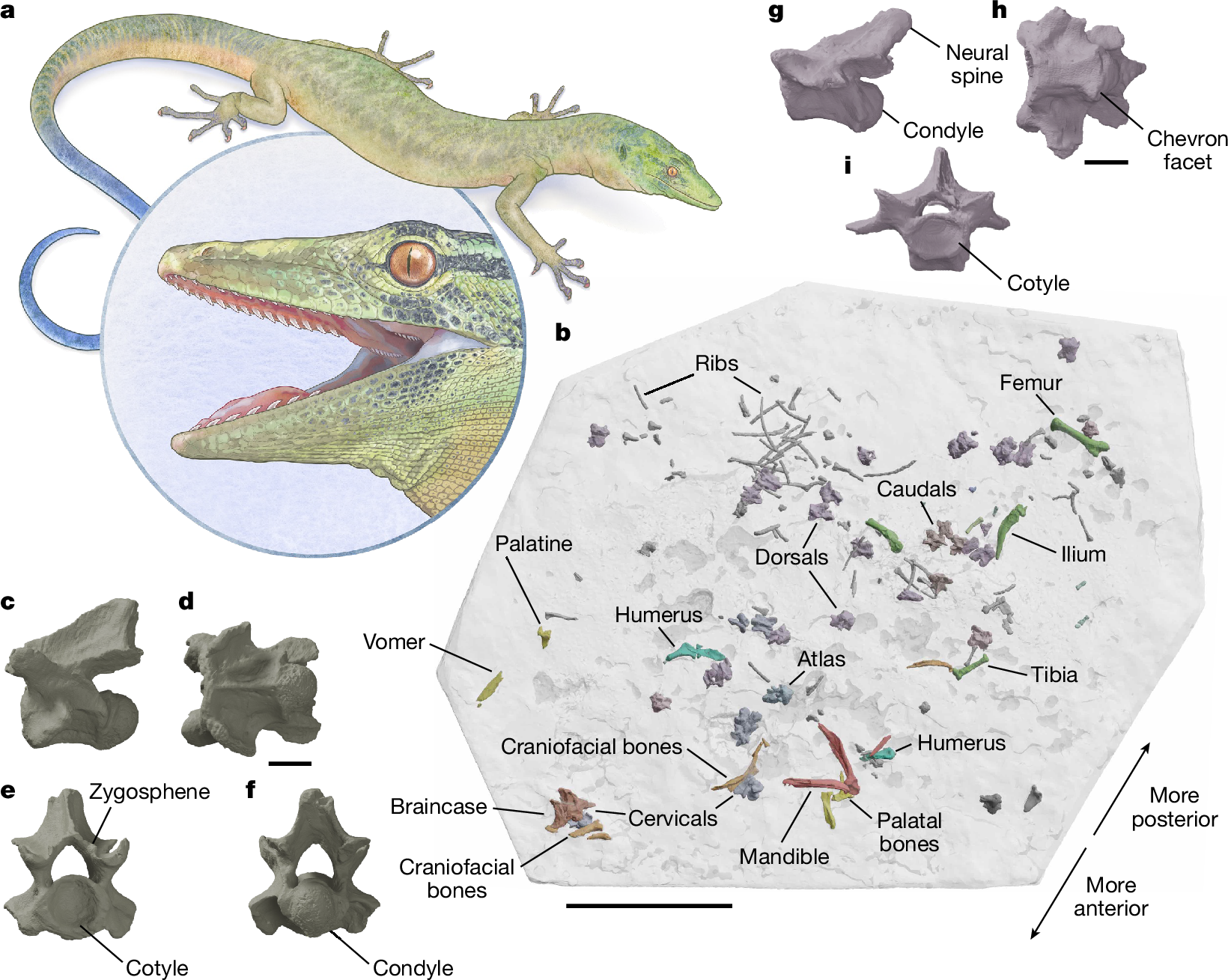
Squamates (lizards and snakes) comprise almost 12,000 living species, with wide ecological diversity and a crown group that originated around 190 million years ago1,2. Conflict between morphology and molecular phylogenies indicates a complex pattern of anatomical transformations during early squamate evolution, which remains poorly understood owing to the scarcity of early fossil taxa1,3. Here we present Breugnathair elgolensis gen. et sp. nov., based on a new skeleton from the Middle Jurassic epoch (167 million years ago) of Scotland, which is among the oldest relatively complete fossil squamates. Breugnathair is placed in a new family, Parviraptoridae, an enigmatic group with potential importance for snake origins, that was previously known from very incomplete remains. It displays a mosaic of anatomical traits that is not present in living groups, with head and body proportions similar to varanids (monitor lizards) and snake-like features of the teeth and jaws, alongside primitive traits shared with early-diverging groups such as gekkotans. Phylogenetic analyses of multiple datasets return conflicting results, with parviraptorids either as early toxicoferans (and potentially stem snakes) or as stem squamates that convergently evolved snake-like dental and mandibular traits related to feeding. These findings indicate high levels of homoplasy and experimentation during the initial radiation of squamates and highlight the potential importance of convergent morphological transformations during deep evolutionary divergences.