2025-10-06 東京科学大学
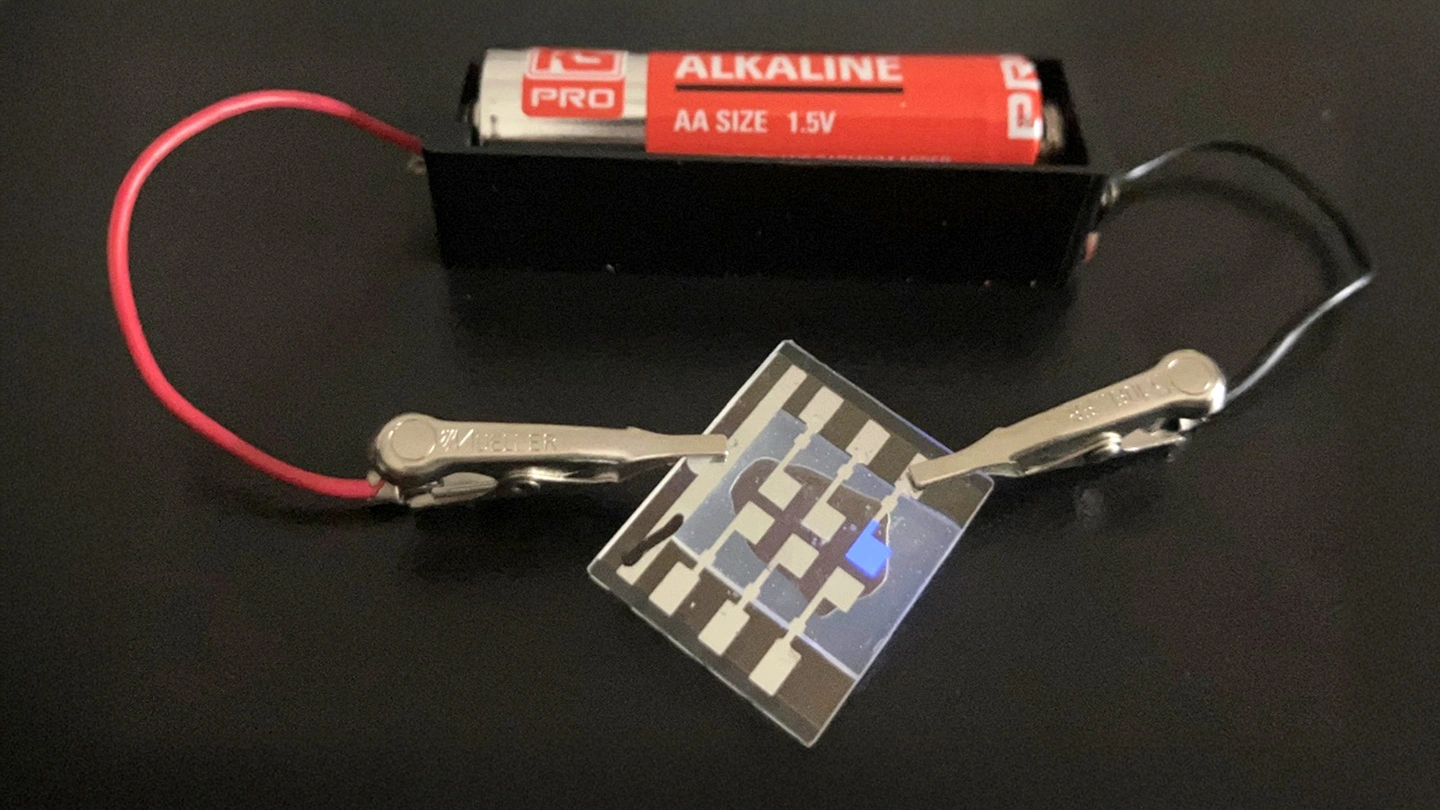
図1.乾電池(1.5 V)1本で深青色有機ELを光らせている写真
<関連情報>
- https://www.isct.ac.jp/ja/news/eelynbxwkn9r
- https://advanced.onlinelibrary.wiley.com/doi/10.1002/adom.202501576
1.5 Vでの有機発光ダイオードによる狭帯域深青色発光 Narrow-Band Deep Blue Emission in Organic Light-Emitting Diode at 1.5 V
Qing-Jun Shui, Hiroto Iwasaki, Daiki Nakahigashi, Yutaka Majima, Seiichiro Izawa
Advances Optical Materials Published: 30 September 2025
DOI;https://doi.org/10.1002/adom.202501576
Abstract
Blue organic light-emitting diodes (OLEDs) are essential components in optoelectronic devices, providing high-energy emissions for vibrant displays and white light illumination. However, their widespread application is hindered by high operating voltages and limited operational lifetimes. Upconversion (UC)-OLEDs, which utilize the triplet–triplet annihilation (TTA) UC process to emit light, offer blue light emission with an ultra-low turn-on voltage of 1.5 V, thereby reducing energy loss and enhancing device longevity. Despite these advantages, the strategy for selecting dopant—key determinants of emission color in UC-OLED—remains unclear, leading to the emission of impure sky-blue light in a previous report. This study investigates the effect of dopants on UC-OLED performance by examining how molecular structure and properties affect charge transport through the formation of deep traps, thereby elucidating dopant selection rules. By developing optimized dopants, a UC-OLED capable of emitting narrowband deep-blue light at 447 nm with a full width at half maximum (FWHM) of 20 nm, driven by a 1.5 V battery, is demonstrated.