2025-10-01 ジョージア工科大学
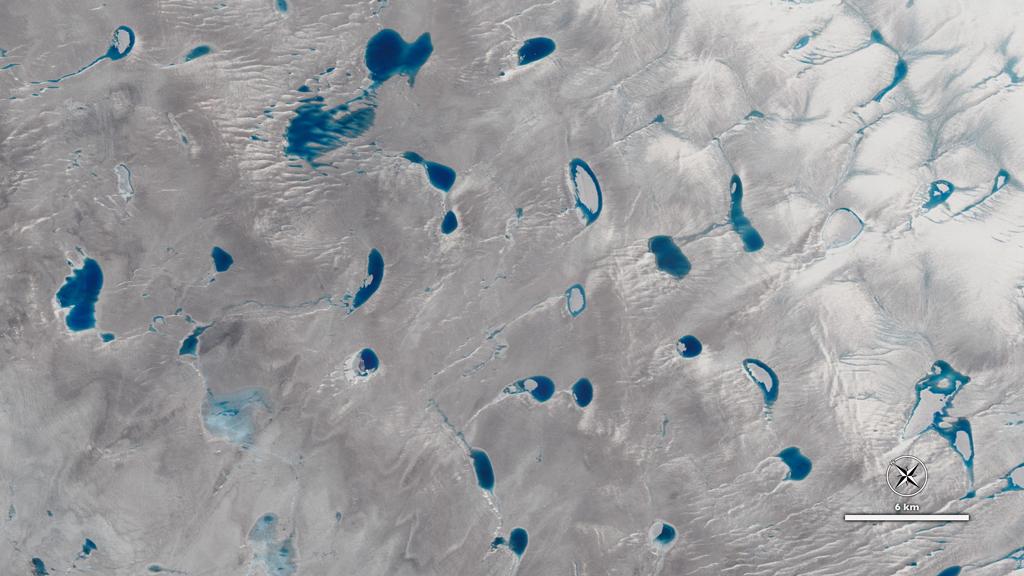
A view of Greenland’s ice sheet from the NASA/USGS Landsat 8 satellite showing meltwater lakes on a glacier. (Credit: NASA)
<関連情報>
- https://research.gatech.edu/future-antarctic-ice-new-study-reveals-mathematics-meltwater-lakes
- https://www.nature.com/articles/s41467-025-61798-8
物理学に基づくパラメータ化による南極氷河融解湖の平均深度と面積率の予測 Predicting mean depth and area fraction of Antarctic supraglacial melt lakes with physics-based parameterizations
Danielle Grau,Azeez Hussain &Alexander A. Robel
Nature Communications Published:15 July 2025
DOI:https://doi.org/10.1038/s41467-025-61798-8
Abstract
Despite the importance of supraglacial melt lakes to the future evolution of polar ice sheets, they are not represented in current large-scale climate and ice sheet models. In this study, we use ICESat-2 satellite surface elevation measurements to show that roughness on the Antarctic Ice Sheet surface is largely self-affine. Estimation of ice sheet surface roughness statistics then enables the development of a set of simple mathematical expressions parameterizing the average supraglacial melt lake area fraction and lake depth from statistical fitting of large simulation ensembles of water flow on random, self-affine surfaces. These parameterizations provide predictions that are generally consistent with observations, with some exceptions. Finally, we predict that on large portions of Antarctic ice shelves supraglacial lakes are likely to, on average, stay less than one meter deep and occupy less than 40% of the ice area, absent changes in ice shelf surface roughness.