2025-10-03 バーミンガム大学
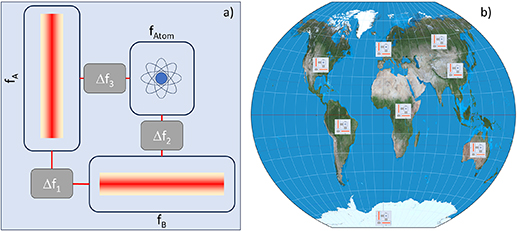
バーミンガム大学とサセックス大学の研究チームは、これまで観測が難しかったミリヘルツ帯(10⁻⁵~1Hz)の重力波を検出する新手法を提案した。LIGOなど地上干渉計が数Hz以上、パルサータイミングアレイがナノヘルツ帯を扱う中、この帯域は“観測の空白域”とされてきた。新方式は超高安定光共振器と原子時計技術を組み合わせ、重力波によるレーザー光の位相変化を高精度に測定する仕組みである。小型で地上設置が可能なため、地震雑音や重力勾配ノイズにも強く、LISAなど宇宙ミッションに頼らず観測を進められる。白色矮星連星やブラックホール合体、初期宇宙の揺らぎなど、多様な信号検出の可能性を開くと期待される。研究者らは現行技術で実現可能とし、時計ネットワークとの統合による低周波拡張も見込む。
<関連情報>
- https://www.birmingham.ac.uk/news/2025/new-approach-to-gravitational-wave-detection-opens-the-milli-hz-frontier
- https://iopscience.iop.org/article/10.1088/1361-6382/ae09ec
光共振器によるミリヘルツ重力波の検出 Detecting milli-Hz gravitational waves with optical resonators
Giovanni Barontini, Xavier Calmet, Vera Guarrera, Aaron Smith and Alberto Vecchio
Classical and Quantum Gravity Published: 3 October 2025
DOI:10.1088/1361-6382/ae09ec
Abstract
We propose a gravitational wave (GW) detector based on ultrastable optical cavities enabling the detection of GW signals in the mostly unexplored 105-1 Hz frequency band. We illustrate the working principle of the detector and discuss that several classes of GW sources, both of astrophysical and cosmological origin, may be within the detection range of this instrument. Our work suggests that terrestrial GW detection in the milli-Hz frequency range is potentially within reach with current technology.

](https://tiisys.com/wp-content/uploads/2025/10/スクリーンショット-2025-10-03-131750.png "個人 セスナ式172P事故[着陸時のオーバーランによる機体損傷](宮城県栗原市 瀬峰場外離着陸場、令和6年10月27日発生)")