
2025-09-30 中国科学院(CAS)
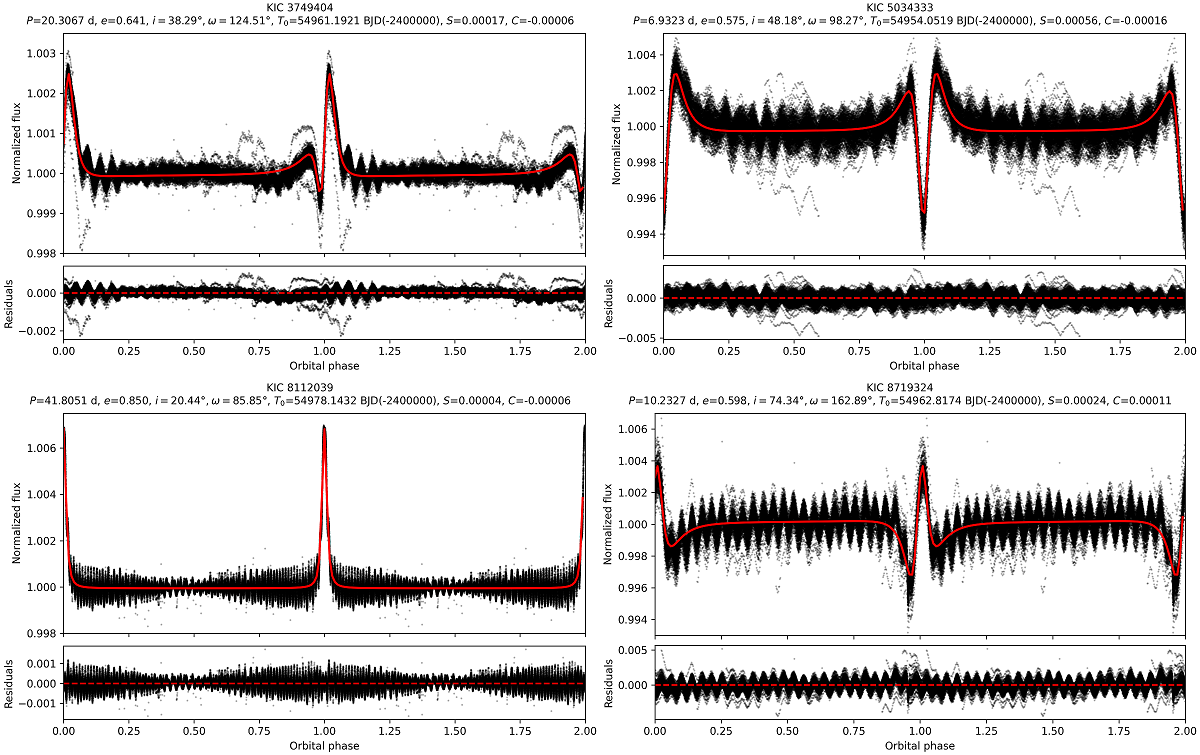
Light curves of four heartbeat stars exhibiting tidally excited oscillations. (Image by LI Minyu)
<関連情報>
- https://english.cas.cn/newsroom/research_news/phys/202509/t20250930_1061224.shtml
- https://iopscience.iop.org/article/10.3847/1538-3881/aded86
リカレントニューラルネットワークに基づくハートビートスター認識:手法と検証 Heartbeat Stars Recognition Based on Recurrent Neural Networks: Method and Validation
Min-Yu Li, Sheng-Bang Qian, Li-Ying Zhu, Wen-Ping Liao, Lin-Feng Chang, Er-Gang Zhao, Xiang-Dong Shi, Fu-Xing Li, Qi-Bin Sun, and Ping Li
The Astronomical Journal Published: 2025 August 13
DOI:10.3847/1538-3881/aded86
Abstract
Since the variety of their light curve morphologies, the vast majority of the known heartbeat stars (HBSs) have been discovered by manual inspection. Machine learning, which has already been successfully applied to the classification of variable stars based on light curves, offers another possibility for the automatic detection of HBSs. We propose a novel feature extraction approach for HBSs. First, the orbital frequencies are calculated automatically according to the Fourier spectra of the light curves. Then, the amplitudes of the first 100 harmonics are extracted. Finally, these harmonics are normalized as feature vectors of the light curve. A training data set of synthetic light curves is constructed using ELLC, and their features are fed into recurrent neural networks (RNNs) for supervised learning, with the expected output being the eccentricity of these light curves. The performance of the RNNs is evaluated using a test data set of synthetic light curves, achieving 95% accuracy. When applied to known HBSs from the Optical Gravitational Lensing Experiment, Kepler, and Transiting Exoplanet Survey Satellite surveys, the networks achieve an average accuracy of 86%. This method successfully identifies four new HBSs within the eclipsing binary catalog of Kirk et al. The use of orbital harmonics as features for HBSs proves to be a practical approach that significantly reduces the computational cost of neural networks. RNNs show excellent performance in recognizing this type of time series data. This method not only allows efficient identification of HBSs but can also be extended to recognize other types of periodic variable stars.


