
2025-09-29 カリフォルニア工科大学(Caltech)
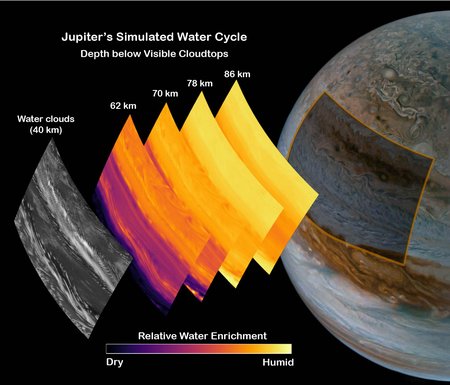
An illustration of Jupiter’s atmosphere at varying depths. Deeper below the cloud layer, water concentrations increase.
Credit: H. Ge
<関連情報>
- https://www.caltech.edu/about/news/a-new-model-of-water-in-jupiters-atmosphere
- https://www.pnas.org/doi/10.1073/pnas.2419087122
木星中緯度における不均一な水分布:降水量と惑星の自転の影響 Nonuniform water distribution in Jupiter’s midlatitudes: Influence of precipitation and planetary rotation
Huazhi Ge, Cheng Li, Xi Zhang, +1 , and Sihe Chen
Proceedings of the National Academy of Sciences Published:September 29, 2025
DOI:https://doi.org/10.1073/pnas.2419087122
Significance
Jupiter is known for its colorful and dynamic appearance. However, its beauty poses a challenge for measuring its composition, as the optimal location for determining metallicity in Jupiter is largely unknown. Recently, Juno found that nonuniform features may extend to the layers well beneath clouds. Here, we examine water distribution in Jupiter’s midlatitudes. High-resolution simulations reveal a nonuniform distribution of water in Jupiter’s weather layer. Precipitation establishes a large-scale depletion of water vapor tens of kilometers beneath water clouds. Turbulent large-scale eddies and waves lead to a latitudinal dependency of water vapor within the depleted levels. Our study highlights the significance of precipitation and large-scale dynamics in accurately measuring the bulk composition of condensable volatiles on giant planets.
Abstract
Knowing the composition of Jupiter’s atmosphere is crucial for constraining Jupiter’s bulk metallicity and formation history. Yet, constraining Jupiter’s atmospheric water abundance is challenging due to its potential nonuniform distribution. Here, we explicitly resolve the water hydrological cycle in Jupiter’s midlatitudes using high-resolution simulations. Falling precipitation leads to a significant large-scale depletion of water vapor beneath the lifting condensation level. A nonuniform water vapor distribution emerges in the midlatitude simulation with a changing Coriolis parameter across latitudes and spatially uniform cooling and heating. Water abundance at the 7-bar level varies by up to a factor of ten across latitudes, from subsolar to supersolar values. We propose that nonlinear large-scale eddies and waves tend to drift air parcels across latitudes along constant potential vorticity (PV) surfaces, thereby sustaining latitudinal dependencies in water vapor and the interplay between water distribution and large-scale dynamics. Therefore, water distribution is influenced by the vertical structure of density stratification and changing Coriolis parameter across Jupiter’s midlatitudes, as quantified by PV. Additionally, the water hydrological cycle amplifies the specific energy of air parcels through the latent heat effect, thereby slowing down vertical mixing with a latent heat flux. The horizontal gradient of water is expected to be more pronounced with a supersolar water abundance. We suggest that similar interplays between precipitating condensates, planetary rotation, and distribution of condensable species generally exist in the weather layer of fast-rotating giant planets. The ongoing Juno mission and future Uranus mission may further reveal the nonuniform distribution of condensed species and their interplay with large-scale dynamics.


