2025-09-12 コンコルディア大学
<関連情報>
- https://www.concordia.ca/cunews/encs/2025/09/12/concordia-researchers-chart-a-sunny-path-for-cleaner-air-taxi-travel.html
- https://www.mdpi.com/2226-4310/12/3/164
持続可能な航空輸送のための太陽光発電システム統合の探求―水上飛行機エアタクシー運用の事例研究 Exploration of Solar Power System Integration for Sustainable Air Transportation—A Case Study for Seaplane Air Taxi Operations
Susan Liscouët-Hanke,Mohammad Mir and Musavir Bashir
Aerospace Published: 20 February 2025
DOI:https://doi.org/10.3390/aerospace12030164
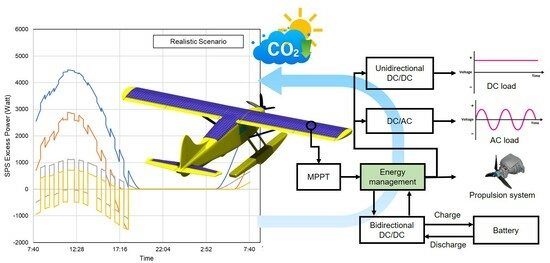
Graphical Abstract
Abstract
To reduce the environmental impact of airborne transportation, the aeronautic community investigates smaller aircraft with short-range operations (such as training aircraft, air taxis, or commuter aircraft) as technology incubators. This paper contributes to this effort by presenting an analysis framework and a detailed case study for integrating an auxiliary solar power system for air taxi operations. The solar power system conceptual design and analysis framework is improved to capture important effects for more realistic analysis for smaller aircraft, such as allowing the solar power system’s efficiency to be estimated as a function of aircraft mission parameters (temperature, speed, cloudiness) and providing a detailed view of the new system’s weight estimation considering potential physical integration scenarios. A detailed analysis of Harbour Air’s seaplane air taxi operations and the DHC-2 Beaver is performed using this enhanced design framework. The results show that the solar power system output exceeds the required secondary electrical power for 86% of the mission in one season; hence, it provides the potential to supplement a hybrid electric propulsion system. Secondly, the authors designed experiments to investigate the sensitivity of technology uncertainties for one critical mission. The results show that a small fuel burn reduction can be achieved with current technologies, with a promising trend of more savings with increasing system efficiency. Also, the results show that accumulated over a season’s operation, the CO2 emissions from the aircraft can be reduced. The findings indicate that integrating solar power systems can supplement traditional power sources and improve ground operations: specifically, solar energy could power a zero-emission and autonomous air-conditioning system while parked. Overall, integrating solar power into seaplane air taxi operations, even as a retrofit, presents a viable strategy for achieving more sustainable air transportation.