2025-09-11 海洋研究開発機構,水産研究・教育機構,東京大学
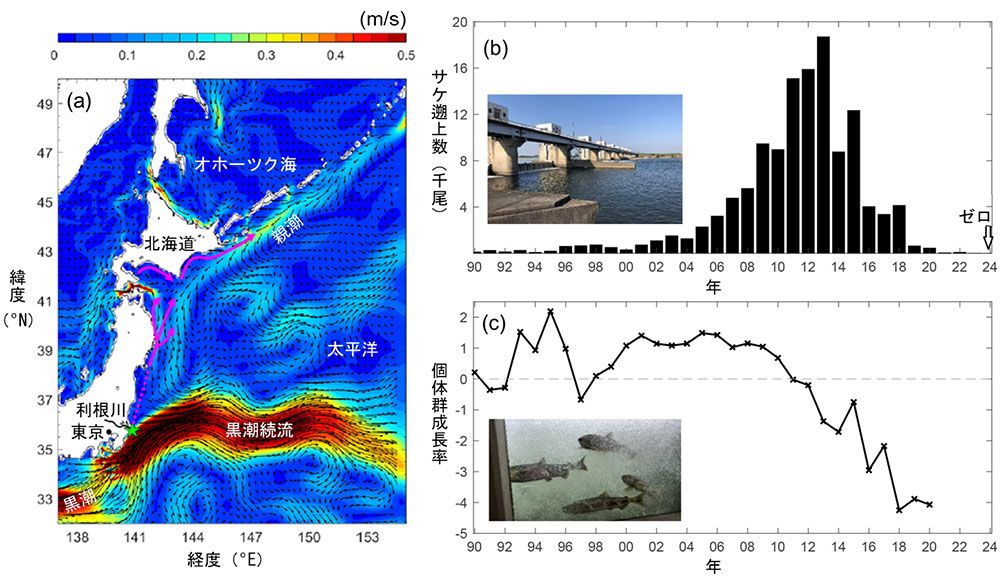 図1. (a) 研究海域と粒子の追跡期間(2001年2月中旬から2020年7月中旬)における5m深の平均流速。利根川(緑の星)を起源とするサケ(Oncorhynchus keta)の潜在的な移動経路をマゼンタ色で示す。実線は先行研究による、破線は推定による経路。(b) 1990年から2024年までの利根川河口の上流150kmに位置する利根大堰で計数されたサケ親魚の数。(c) 1世代を4年と仮定した利根川サケの個体群成長率。写真はそれぞれ2018年11月に撮影された(b)利根大堰、(c)魚道の観察窓で撮影されたサケ親魚。
<関連情報>
- https://www.jamstec.go.jp/j/about/press_release/20250911_2/
- https://journals.plos.org/plosone/article?id=10.1371/journal.pone.0330957
致死温度を超えて:気候変動下におけるサケの南部生息域からの消失要因 Beyond lethal temperatures: Factors behind the disappearance of chum salmon from their southern margins under climate change
Yu-Lin K. Chang ,Kentaro Honda,Kentaro Morita
PLOS One Published: September 10, 2025
DOI:https://doi.org/10.1371/journal.pone.0330957
Abstract
The Tone River in Japan represents one of the southern limit distributions of chum salmon (Oncorhynchus keta) on the western side of the North Pacific, but the number of adult chum salmon observed here has declined dramatically since 2013 and reached zero in 2024. The factors behind the recent decline of the chum salmon population in the Tone River were investigated by using ocean reanalysis data and a 20-year particle-tracking simulation. Virtual chum salmon fry were released at the mouth of the Tone River in spring each year with six different swimming strategies to evaluate the effects of ocean currents on the population growth rate of salmon. None of the simulated scenarios reproduced the recent decline in the population, regardless of the swimming strategy and addition of lethal temperature thresholds. Instead, the decline in population growth rate appears to be correlated with warming water temperature and reduced zooplankton abundance caused by the northward shifts of the Kuroshio/Kuroshio Extension and Oyashio. Along the coast of northeastern Japan, the warm, nutrient-poor Kuroshio/Kuroshio Extension replaced the cold, nutrient-rich Oyashio on the migration route of chum salmon fry, increasing the water temperature and reducing zooplankton abundance. Partial correlation analysis of the water temperature and zooplankton abundance indicated that the latter was the main influencing factor coherently related to the population growth rate of salmon. The reduced zooplankton abundance would affect the growth and survival of chum salmon fry, which would result in a decline in population growth. The northward shift of the Kuroshio/Kuroshio Extension and Oyashio may continue or return southward depending on the effects of climate change, which will greatly influence the future population growth of chum salmon and whether they come back to the Tone River.