2025-09-01 中国科学院(CAS)
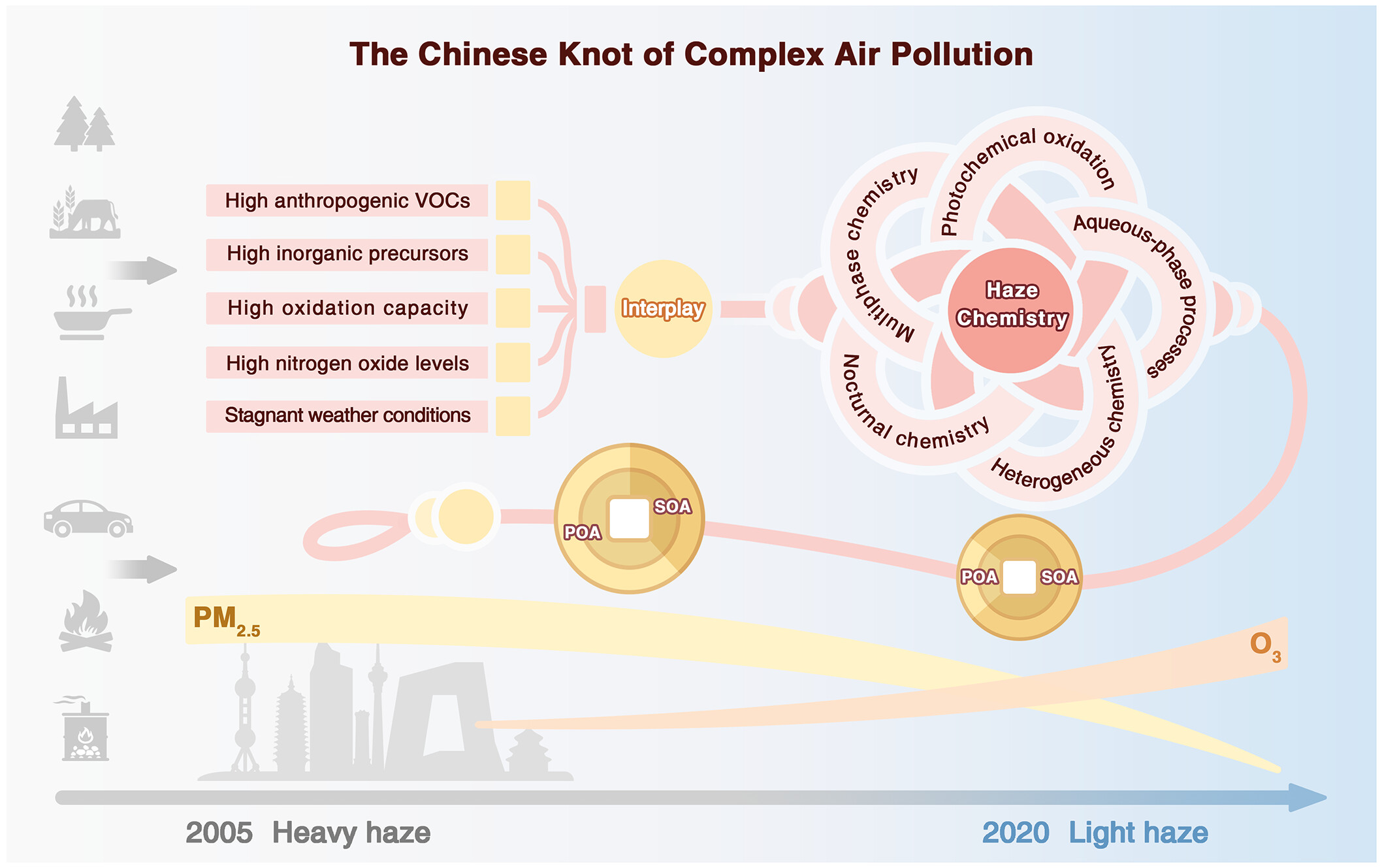
The Chinese knot of complex air pollution explains a distinct chemical regime for SOA formation in urban China. (Image by Prof. HUANG Rujin)
<関連情報>
- https://english.cas.cn/newsroom/research_news/earth/202509/t20250901_1051840.shtml
- https://www.science.org/doi/10.1126/science.adq2840
中国都市部における二次有機エアロゾル:大気汚染研究のための特異な化学的特性 Secondary organic aerosol in urban China: A distinct chemical regime for air pollution studies
Ru-Jin Huang, Yong Jie Li, Qi Chen, Yanli Zhang, […] , and Marianne Glasius
Science Published:28 Aug 2025
DOI:https://doi.org/10.1126/science.adq2840
Editor’s summary
Urban air pollution in China is characterized by a chemical environment not seen in many other places in the world, with strong haze events being a particularly visible symptom. The high particulate matter loads that define these hazy episodes are largely the result of the production of secondary organic aerosols (SOAs). Huang et al. reviewed the state of the science of SOA formation under the distinctive chemical conditions in urban China, paying particular attention to the roles of anthropogenic precursors relative to biogenic ones, the prevailing SOA formation and aging mechanisms, and the interplay between inorganic and organic pollutants. —Jesse Smith
Structured Abstract
BACKGROUND
Air pollution is a global environmental problem with far-reaching implications for air quality, climate, ecosystems, and human health. Over the recent decades, China has experienced severe haze pollution, also called “complex air pollution.” These haze extremes are characterized by high concentrations of fine particulate matter (smaller than 2.5 μm, or PM2.5) and occur with extensive temporal and spatial coverage, although the situation was alleviated after 2013, owing to regulatory efforts. Distinct from the historical London fog caused mainly by coal combustion and the Los Angeles smog mainly formed by the photochemical oxidation of vehicular exhaust, haze pollution in China stems from high primary emissions and efficient secondary formation. One distinct feature of China at the current stage is a blend of agricultural and industrial societies, leading to high emissions of secondary aerosol precursors from diverse sources. These include NH3 from agricultural activities and anthropogenic volatile organic compounds (VOCs) from residential coal combustion and straw burning for heating and cooking (features of an agricultural society), as well as NOx (NO + NO2), SO2, and anthropogenic VOCs from vehicular exhaust and industrial activities (features of an industrial society). The mixture of these abundant inorganic and organic precursors can largely change the yields, chemical speciation, and formation pathways of secondary organic aerosol (SOA).
ADVANCES
Numerous studies have revealed that air pollution in urban China is not only of enormous magnitude but also represents a distinct chemical regime less commonly observed elsewhere. The efficient formation of secondary aerosol in winter is distinct, which to a large extent drives the haze formation, particularly in recent winters after large reduction of primary aerosol. Higher-than-expected atmospheric oxidizing capacity in winter China is a combined result of photolysis of elevated HONO, alkene ozonolysis in the presence of NOx, anthropogenic halogen radicals, and the O2/H2O-involved interfacial oxidation and hydrolysis processes. This represents a previously unidentified chemical regime to describe the explosive growth of SOA and secondary inorganic aerosol in complex air pollution. In addition, the elevated NOx levels can lead to the formation of a variety of nitrogen-containing multifunctional oxidation products. For example, secondary organic nitrate was reported to account for more than 40% of organic aerosol mass during haze events in urban China, which is important for SOA enhancement and altered physicochemical properties. Also, the formation of peroxyacyl nitrates may worsen the regional air pollution by prolonging the effective lifetime of peroxyl radicals. Moreover, the increasing fractional contribution of nitrate over sulfate in recent years results in enhanced aerosol liquid water content, promoting aqueous-phase SOA formation, as revealed through multiple field studies during humid haze events.
OUTLOOK
Despite considerable advances over the past decade, the precursors, formation, and transformation of SOA in urban China and their impacts on the radiative budget and human health are still very uncertain. Molecular-level speciation of SOA precursors and multigeneration products are essential to elucidate the formation and fate of SOA, and particular focus should be given to less-explored precursors, such as semivolatile and intermediate-volatility organic compounds and volatile chemical products. Noticeably, the sharp decrease of PM2.5 concentrations in urban China over the past decade, which has not been reported anywhere else, has led to a substantial increase of surface O3 concentrations, which facilitates the formation of SOA. Quantitative understanding of the unrecognized sources responsible for the enhanced atmospheric oxidizing capacity in winter urban China is therefore critical. With accurate parameterizations of the above aspects, an improved SOA simulation is expected. As for mitigation, diagnosing the O3-NOx-VOC sensitivity at the city or regional scale is essential for a cost-effective strategy to prioritize control measures on precursors that lead to both high SOA and high O3 concentrations.
 The distinct chemical regime for SOA formation in urban China.
The interplay of high anthropogenic VOCs, NOx, NH3, and SO2 from diverse emission sources results in high SOA formation that involves photochemical oxidation, aqueous-phase processes, nocturnal chemistry, heterogeneous chemistry, and multiphase chemistry, especially under stagnant weather conditions. There was a large increase of SOA relative to primary organic aerosol (POA) after the Clean Air Act.
Abstract
In the past decades, China has witnessed high air pollution associated with rapid economic development, although regulatory efforts have alleviated the situation since 2013. Haze events characterized by high particulate matter (PM) levels in China are not only of enormous magnitude but also represent a distinct chemical regime. Once driven by direct emissions, these high-PM episodes are now more affected by secondary aerosol, especially secondary organic aerosol (SOA). This Review synthesizes the state of the science of SOA formation in urban China, specifically (i) how the dominance of anthropogenic precursors affects SOA formation, (ii) what are the prevailing SOA formation mechanisms, and (iii) how important are the multipollutant and multiphase processes in SOA formation and evolution. We also highlight essential directions for future studies.