2025-08-26 北海道大学
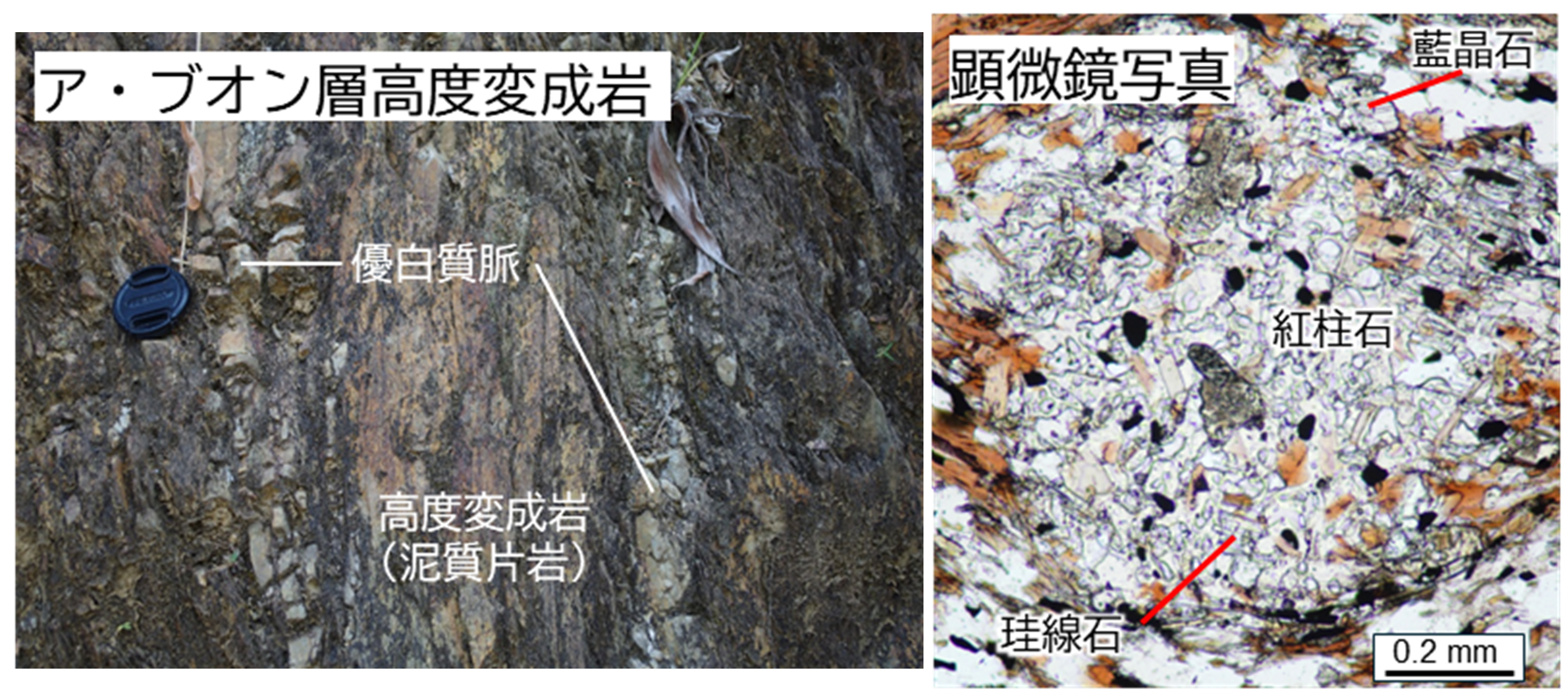
(左)ア・ブオン層から発見された高度変成岩の野外での産状
(右)高度変成岩に含まれるアルミノケイ酸塩鉱物3種(紅柱石・珪線石・藍晶石)の顕微鏡写真
<関連情報>
- https://www.hokudai.ac.jp/news/2025/08/post-2035.html
- https://www.hokudai.ac.jp/news/pdf/250826_pr.pdf
- https://vjs.ac.vn/jse/article/view/23301
ベトナムチョン・ソン帯南部ア・ブオン層の変成作用 Metamorphism in the A Vuong Formation, southern Truong Son Belt, Vietnam
Vuong Bui Thi Sinh, Ippei Kitano, Tuan-Anh Tran, Can Pham-Ngoc, Ly Vu Hoang, Lien Pham Thi Phuong, Huong Ngo Thi, Cong Tran Quoc
Vietnam Journal of Earth Sciences Published:13-08-2025
DOI:https://doi.org/10.15625/2615-9783/23301
Abstract
The A Vuong Formation, located within the southern Truong Son Belt in central Vietnam, comprises low- to high-grade metamorphic rocks that record crucial insights into the region’s tectonic evolution. Our field investigations reveal that it mainly consists of the psammitic and pelitic schists, intercalated with some mafic or siliceous layers, and locally cut by leucocratic veins. The indicative mineral assemblages in the pelitic to psammitic schists define two metamorphic zones: a greenschist-facies biotite-chlorite zone and an amphibolite-facies staurolite zone. Based on conventional geothermobarometry, the peak metamorphic condition in the staurolite zone was estimated at ca. 5.5–8.7 kbar and 590–640℃, followed by a retrograde stage at 4.4–7.4 kbar and 530–570℃. Notably, a porphyroblastic andalusite observed in a pelitic schist from this zone is rimmed by kyanite with a preferred orientation. In addition, it includes kyanite, sillimanite, and an intergrowth of staurolite + quartz as inclusions. These features suggest their equilibrium during the prograde stage, reflecting a pressure-temperature transition from andalusite to kyanite stability. The prograde metamorphic condition is thus constrained at the triple point of andalusite-kyanite-sillimanite. The petrological evidence and estimated metamorphic conditions for the current pelitic schists support a unique anti-clockwise pressure-temperature trajectory, rather than a clockwise one. Its thermobaric feature is well aligned with the amphibolite-facies metamorphism of the neighboring Dai Loc Complex, and contrasts with that of the Kham Duc Complex (Kontum Massif).