2025-08-21 ノースウェスタン大学
<関連情報>
- https://news.northwestern.edu/stories/2025/08/root-beer-float-bursts-home-is-located-with-extraordinary-precision/
- https://iopscience.iop.org/article/10.3847/2041-8213/adf62f
FRB 20250316A:13 pcの精度で特定された、輝かしい近傍の一回限りの高速電波バースト FRB 20250316A: A Brilliant and Nearby One-off Fast Radio Burst Localized to 13 pc Precision
The CHIME/FRB Collaboration:, Thomas C. Abbott, Daniel Amouyal, Bridget C. Andersen, Shion E. Andrew, Kevin Bandura, Mohit Bhardwaj, Kalyani Bhopi, Yash Bhusare, Charanjot Brar,…
The Astrophysical Journal Letters Published: 2025 August 21
DOI:10.3847/2041-8213/adf62f
Abstract
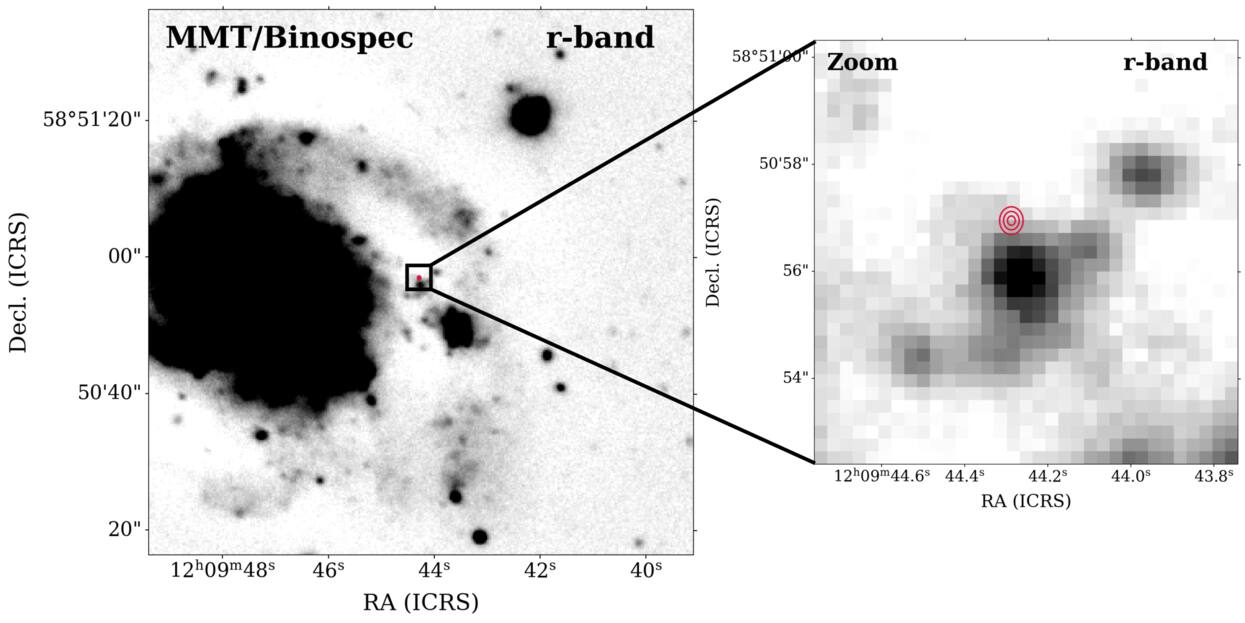
Precise localizations of a small number of repeating fast radio bursts (FRBs) using very long baseline interferometry (VLBI) have enabled multiwavelength follow-up observations revealing diverse local environments. However, the 2%–3% of FRB sources that are observed to repeat may not be representative of the full population. Here we use the VLBI capabilities of the full CHIME Outrigger array for the first time to localize a nearby (40 Mpc), bright (kJy), and apparently one-off FRB source, FRB 20250316A, to its environment on 13 pc scales. We use optical and radio observations to place deep constraints on associated transient emission and the properties of its local environment. We place a 5σ upper limit of L9.9 GHz < 2.1 × 1025 erg s−1 Hz−1 on spatially coincident radio emission, a factor of 100 lower than any known compact persistent radio source associated with an FRB. Our Keck Cosmic Webb Imager observations allow us to characterize the gas density, metallicity, nature of gas ionization, dust extinction, and star formation rate through emission line fluxes. We leverage the exceptional brightness and proximity of this source to place deep constraints on the repetition of FRB 20250316A and find that it is inconsistent with all well-studied repeaters given the nondetection of bursts at lower spectral energies. We explore the implications of a measured offset of 190 ± 20 pc from the center of the nearest star formation region in the context of progenitor channels. FRB 20250316A marks the beginning of an era of routine localizations for one-off FRBs on tens of milliarcseconds scales, enabling large-scale studies of their local environments.