
2025-08-25 カリフォルニア大学リバーサイド校(UCR)
<関連情報>
- https://news.ucr.edu/articles/2025/08/25/how-build-larger-more-reliable-quantum-computers
- https://journals.aps.org/pra/abstract/10.1103/xqrn-wdw1
- https://www.nature.com/articles/s41534-024-00855-4
最適化されたノイズ耐性表面コードテレポーテーションインターフェース Optimized noise-resilient surface code teleportation interfaces
Mohamed A. Shalby, Renyu Wang, Denis Sedov, and Leonid P. Pryadko
Physical Review A Published: 22 August, 2025
DOI: https://doi.org/10.1103/xqrn-wdw1
Abstract
Connecting two surface-code patches may require significantly higher noise at the interface. We show, via circuit-level simulations under a depolarizing noise model with idle errors, that surface codes remain fault tolerant despite substantially elevated interface error rates. Specifically, we compare three strategies—direct noisy links, gate teleportation, and a CAT-state gadget—for both rotated and unrotated surface codes, and demonstrate that careful design can mitigate hook errors in each case so that the full code distance is preserved for both and . Although these methods differ in space and time overhead and performance, each offers a viable route to modular surface-code architectures. Our results, obtained with stim and pymatching, confirm that high-noise interfaces can be integrated fault-tolerantly without compromising the code’s essential properties, indicating that fault-tolerant scaling of error-corrected modular devices is within reach with current technology.
誤り訂正された量子ビットとノイズの多いリンクのフォールトトレラント接続 Fault-tolerant connection of error-corrected qubits with noisy links
Joshua Ramette,Josiah Sinclair,Nikolas P. Breuckmann & Vladan Vuletić
npj Quantum Information Published:10 June 2024
DOI:https://doi.org/10.1038/s41534-024-00855-4
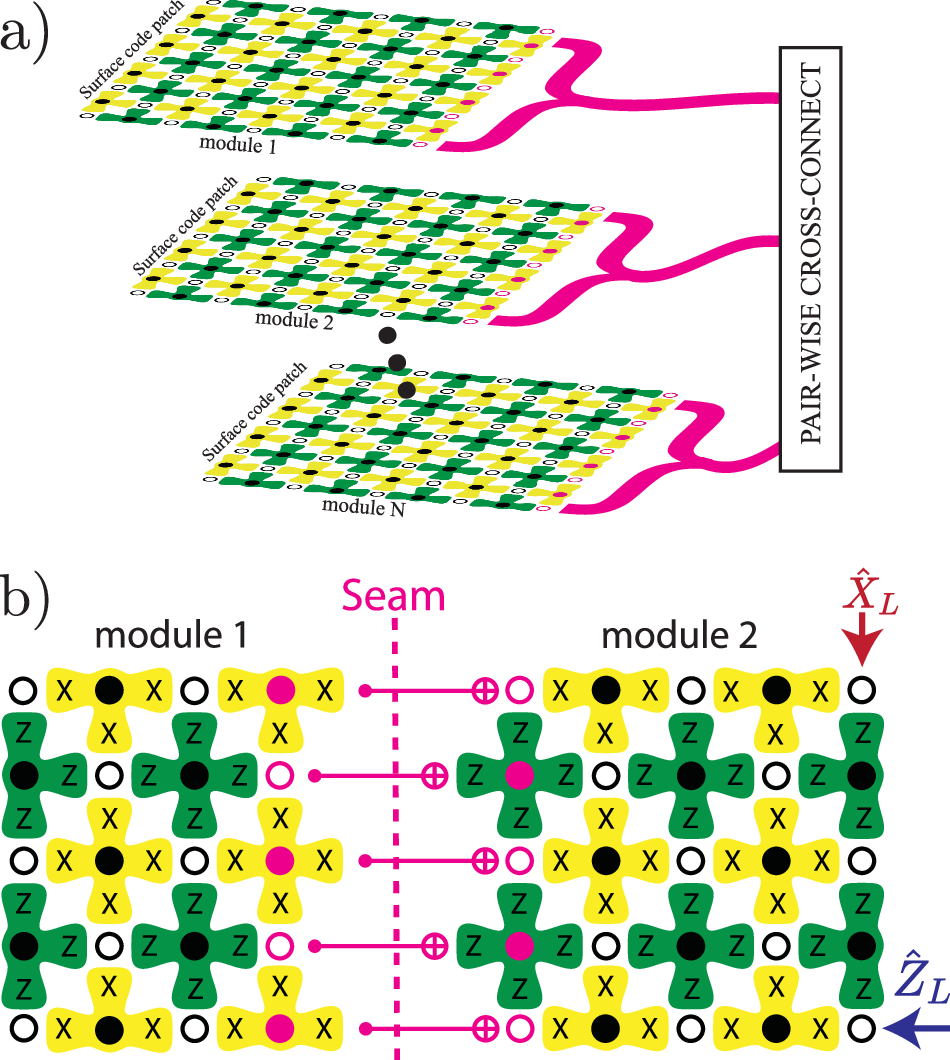
Abstract
One of the most promising routes toward scalable quantum computing is a modular approach. We show that distinct surface code patches can be connected in a fault-tolerant manner even in the presence of substantial noise along their connecting interface. We quantify analytically and numerically the combined effect of errors across the interface and bulk. We show that the system can tolerate 14 times higher noise at the interface compared to the bulk, with only a small effect on the code’s threshold and subthreshold behavior, reaching threshold with ~1% bulk errors and ~10% interface errors. This implies that fault-tolerant scaling of error-corrected modular devices is within reach using existing technology.


