2025-08-19 中国科学院(CAS)
<関連情報>
- https://english.cas.cn/newsroom/research_news/chem/202508/t20250821_1051153.shtml
- https://www.nature.com/articles/s44286-025-00262-2
スケーラブルな金属有機フレームワーク(MOF)ベースの電極を用いた効率的なアルカリ性水電解 Scalable metal–organic framework-based electrodes for efficient alkaline water electrolysis
Yingjie Guo,Lei Shi,Xinshuo Shi,Tingting Zhao,Weichen Tian,Songlin Zhang,Di Liu,Yanzhe Li,Faping Zhong & Shenlong Zhao
Nature Chemical Engineering Published:19 August 2025
DOI:https://doi.org/10.1038/s44286-025-00262-2
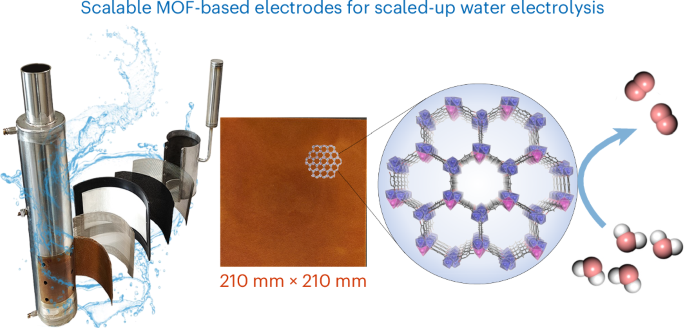
Abstract
Renewable electricity-driven water splitting is essential for decarbonizing high-emission industries and transportation. Metal–organic frameworks (MOFs) have shown great promise as catalytic materials for water splitting, but substantial gaps remain between fundamental research and practical application. Here we report the scalable and rapid synthesis of CoCe MOFs for alkaline water-splitting electrolyzers, achieving low energy consumption (4.11 kWh Nm−3 H2) and long-term stability (5,000 h). Experiments indicate that the advantageous physiochemical properties of CoCe MOFs such as lattice distortion and large specific surface area enhance catalytic activity, facilitate water and gas transport and improve electrolyte accessibility to catalytic interfaces in practical devices. Preliminary techno-economic analysis shows that the cost of hydrogen produced from the CoCe MOF-based electrolyzer is US$2.71 kg−1, which is close to the target cost set by the US Department of Energy, and a life cycle assessment indicates that green hydrogen has up to 84.5% lower life cycle carbon emissions than traditional gray hydrogen production pathways.