2025-08-21 パシフィック・ノースウェスト国立研究所 (PNNL)
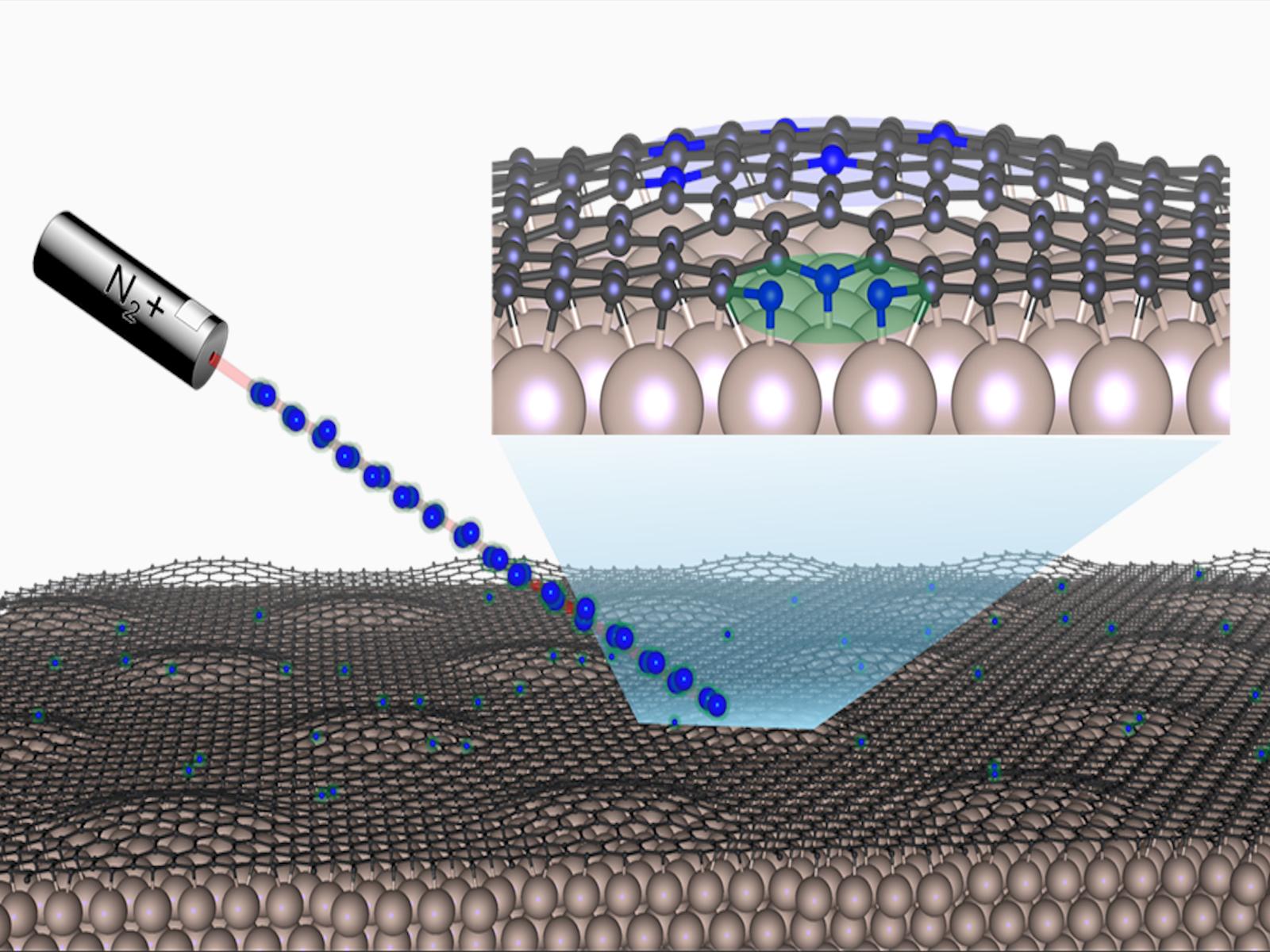 A combination of microscopy and modeling enables researchers to investigate the role of the support in controlling the location of pyridinic and graphitic nitrogen in graphene on ruthenium.
(Image by Peter Rice and Zbynek Novotny | Pacific Northwest National Laboratory)
<関連情報>
- https://www.pnnl.gov/publications/understanding-and-controlling-nitrogen-speciation-doped-graphene
- https://advanced.onlinelibrary.wiley.com/doi/10.1002/admi.202500142
Ru(0001)上のグラフェンモイアにおけるグラファイト型およびピリジン型窒素の熱力学的安定性とサイト特異的分布 Thermodynamic Stability and Site-Specific Distribution of Graphitic and Pyridinic Nitrogen in Graphene Moiré on Ru(0001)
Buddhika S. A. Gedara, Peter S. Rice, Prescott E. Evans, Daniel Baranowski, Marcus A. Sharp, Tom Autrey, Bojana Ginovska, Zdenek Dohnálek, Zbynek Novotny
Advanced Materials Interfaces Published: 27 April 2025
DOI:https://doi.org/10.1002/admi.202500142
Abstract
Graphene-like materials are of interest for large-scale hydrogen storage applications due to their lightweight, durable, and scalable properties. Nitrogen-doping minimizes kinetic limitations in diffusion and recombination on surfaces, however, the role of graphitic nitrogen (GN) and pyridinic nitrogen (PN) is not well understood. Nitrogen-doped graphene is synthesized on Ru(0001) using chemical vapor deposition (CVD) of pyridine and ion irradiation. Scanning tunneling microscopy (STM), x-ray photoelectron spectroscopy (XPS), and density functional theory (DFT) are used to identify the structure, location, and thermodynamic stability of nitrogen species within the graphene moiré. CVD of pyridine results in a low nitrogen concentration (<0.1at%), while the post-growth nitrogen ion irradiation allows us to increase the concentration further. The concentration of GN and PN is controlled by varying the ion dose and annealing temperature. Comparison of measured and simulated STM images of GN and PN yield an excellent agreement, allowing us to confidently establish that GN is preferentially located near the center of the Atop region, while PN is located in the valley region of the graphene moiré. This report explicitly confirms the site assignments and provides a foundation for the site synthesis and analysis of structural and electronic properties that drive the reactivity of N-doped graphene.