2025-08-20 米国国立再生可能エネルギー研究所(NREL)
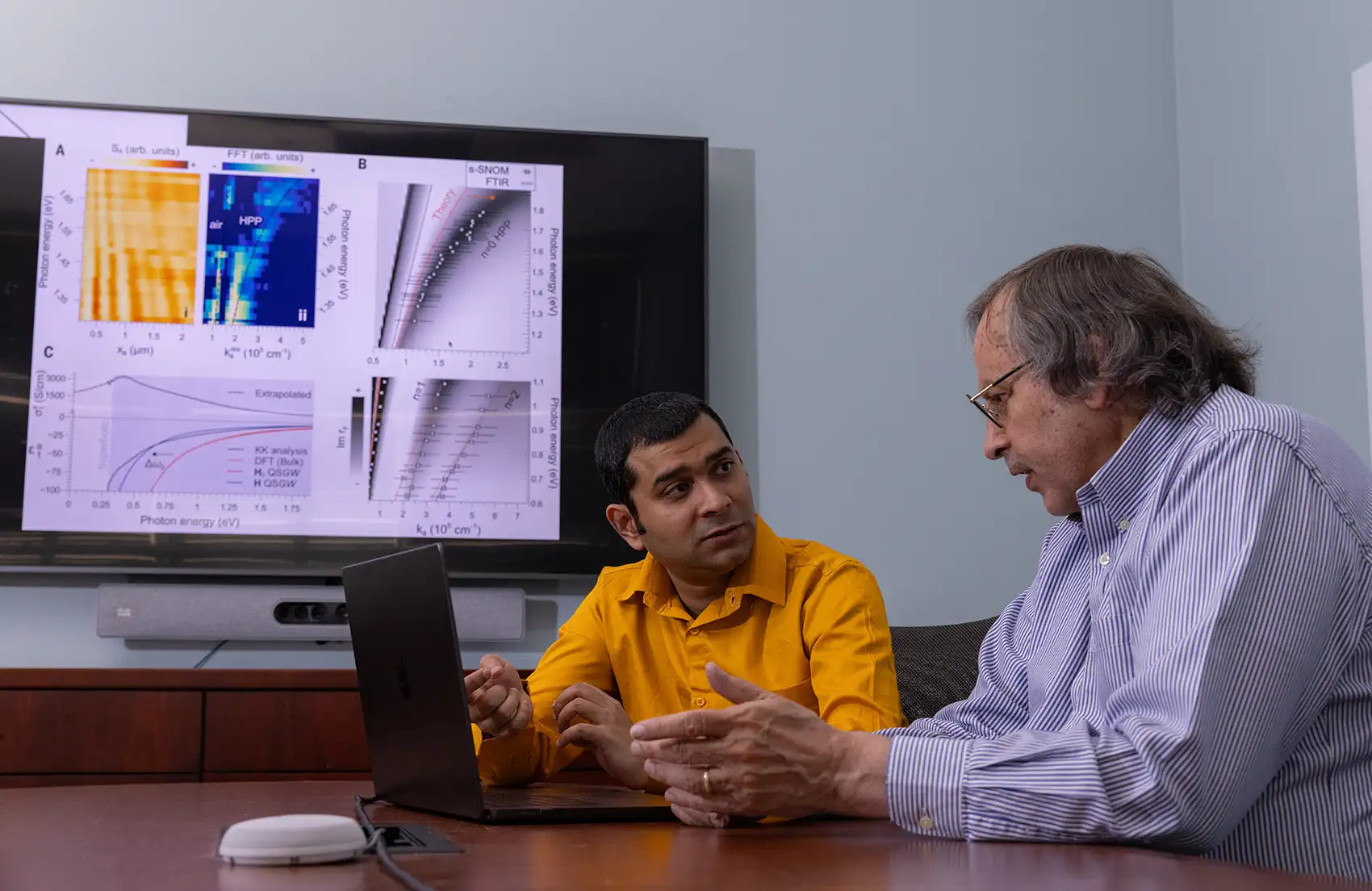 NREL researchers Swagata Acharya (left) and Mark van Schilfgaarde discuss their research on plasmon resilience in strongly correlated systems. Photo by Agata Bogucka, NREL
<関連情報>
- https://www.nrel.gov/news/detail/program/2025/breaking-rules-but-not-waves-plasmons-in-correlated-materials
- https://www.science.org/doi/10.1126/science.adr5926
悪い金属中の良いプラズモン Good plasmons in a bad metal
Francesco L. Ruta, Yinming Shao, Swagata Acharya, Anqi Mu, […] , and D. N. Basov
Science Published:13 Feb 2025
DOI:https://doi.org/10.1126/science.adr5926
Editor’s summary
Plasmonics offers a route to shrink light wavelengths down to the nanoscale using collective electronic excitations. Intuitively, highly conducting metals are the materials of choice, providing for long plasmon lifetime. Ruta et al. looked at the so-called “bad metal” molybdenum oxide dichloride, in which electronic correlations give rise to high resistivity. Surprisingly, they observed plasmons with very long lifetimes. The unexpected finding of long-lifetime plasmons may provide a route to expanding the choice of materials for nanophotonic applications. —Ian S. Osborne
Abstract
Correlated metals may exhibit unusually high resistivity that increases linearly in temperature, breaking through the Mott-Ioffe-Regel bound, above which coherent quasiparticles are destroyed. The fate of collective charge excitations, or plasmons, in these systems is a subject of debate. Several studies have suggested that plasmons are overdamped, whereas other studies have detected propagating plasmons. In this work, we present direct nano-optical images of low-loss hyperbolic plasmon polaritons (HPPs) in the correlated van der Waals metal MoOCl2. HPPs are plasmon-photon modes that waveguide through extremely anisotropic media and are remarkably long-lived in MoOCl2. Photoemission data presented here reveal a highly anisotropic Fermi surface, reconstructed and made partly incoherent, likely through electronic interactions as explained by many-body theory. HPPs remain long-lived despite this, revealing previously unseen imprints of many-body effects on plasmonic collective modes.