
2025-08-20 チャルマース工科大学
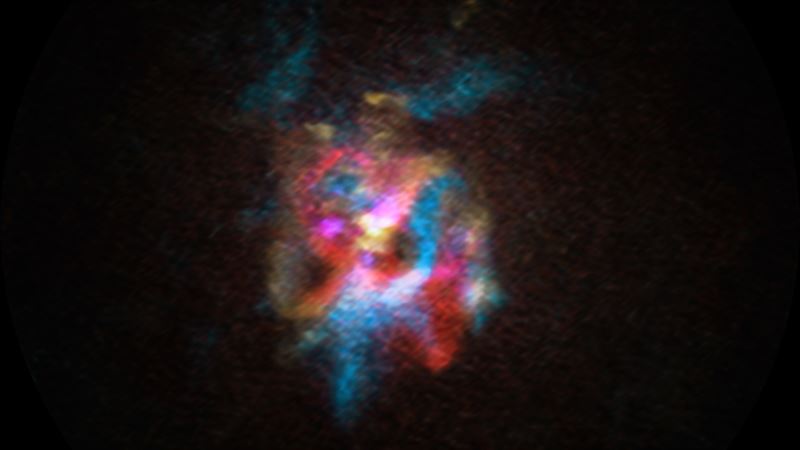 Astronomers from Chalmers University of Technology, Sweden, have discovered a vast and expanding bubble of gas and dust surrounding a red supergiant star – the largest structure of its kind ever seen in the Milky Way. The bubble, which contains as much mass as the Sun, was blown out in a mysterious stellar eruption around 4000 years ago. Why the star survived such a powerful event is a puzzle, the scientists say.
<関連情報>
- https://news.cision.com/chalmers/r/supergiant-star-s-gigantic-bubble-surprises-scientists,c4219540
- https://www.aanda.org/articles/aa/full_html/2025/08/aa55975-25/aa55975-25.html
ステフェンソン2 DFK 52:巨大恒星団RSGC2における希少な赤色超巨星の発見 Stephenson 2 DFK 52: Discovery of an exotic red supergiant in the massive stellar cluster RSGC2
M. A. Siebert, E. De Beck, G. Quintana-Lacaci and W. H. T. Vlemmings
Astronomy & Astrophysics Published:06 August 2025
DOI:https://doi.org/10.1051/0004-6361/202555975
Abstract
Atacama Large Millimeter/submillimeter Array (ALMA) observations at 1.3 mm have recently revealed surprising complexity in the circumstellar environment of DFK 52, a red supergiant (RSG) located in the Stephenson 2 massive open cluster. We provide an initial characterisation of the star’s mass-loss properties by studying its circumstellar emission in continuum, 12CO, 13CO, and SiO rotational lines. We find that DFK 52 is surrounded by an extremely large outflow (up to 50 000 au in radius) that shows complex morphologies in both its molecular and dust emission. The size of the circumstellar medium is unprecedented, even when compared with other known extreme RSGs, and its lower luminosity indicates that its mass ejection mechanism may be unique among this population. The molecular emission can be partially reproduced by a two-component model consisting of a fast (27 km s−1) detached equatorial component with M ∼ 0.05 M⊙ and a slow (10 km s−1) spherical envelope with Ṁ ∼ 3 × 10⁻⁶ M⊙ yr−1. This suggests that DFK 52 underwent a dramatic mass-loss event ∼4000 years ago, but has since transitioned into having a slower more symmetric mass loss. We conservatively estimate a total mass of 0.1 − 1 M⊙ in the complex extended regions of the outflow. The uncertain nature of the dramatic mass loss warrants extensive follow-up of this likely supernova progenitor.



