2025-08-18 カリフォルニア大学リバーサイド校(UCR)
<関連情報>
- https://news.ucr.edu/articles/2025/08/18/trees-tropics-cool-more-burn-less
- https://www.nature.com/articles/s41612-025-01127-4
CMIP6モデルにおける将来のネット植林シナリオの気候影響 Climate effects of a future net forestation scenario in CMIP6 models
James L. Gomez,Robert J. Allen,Larry W. Horowitz,Steven T. Turnock,Rosie A. Fisher,Olivia E. Clifton,Bryan K. Mignone,Elena Shevliakova & Sergey Malyshev
npj Climate and Atmospheric Science Published:08 August 2025
DOI:https://doi.org/10.1038/s41612-025-01127-4
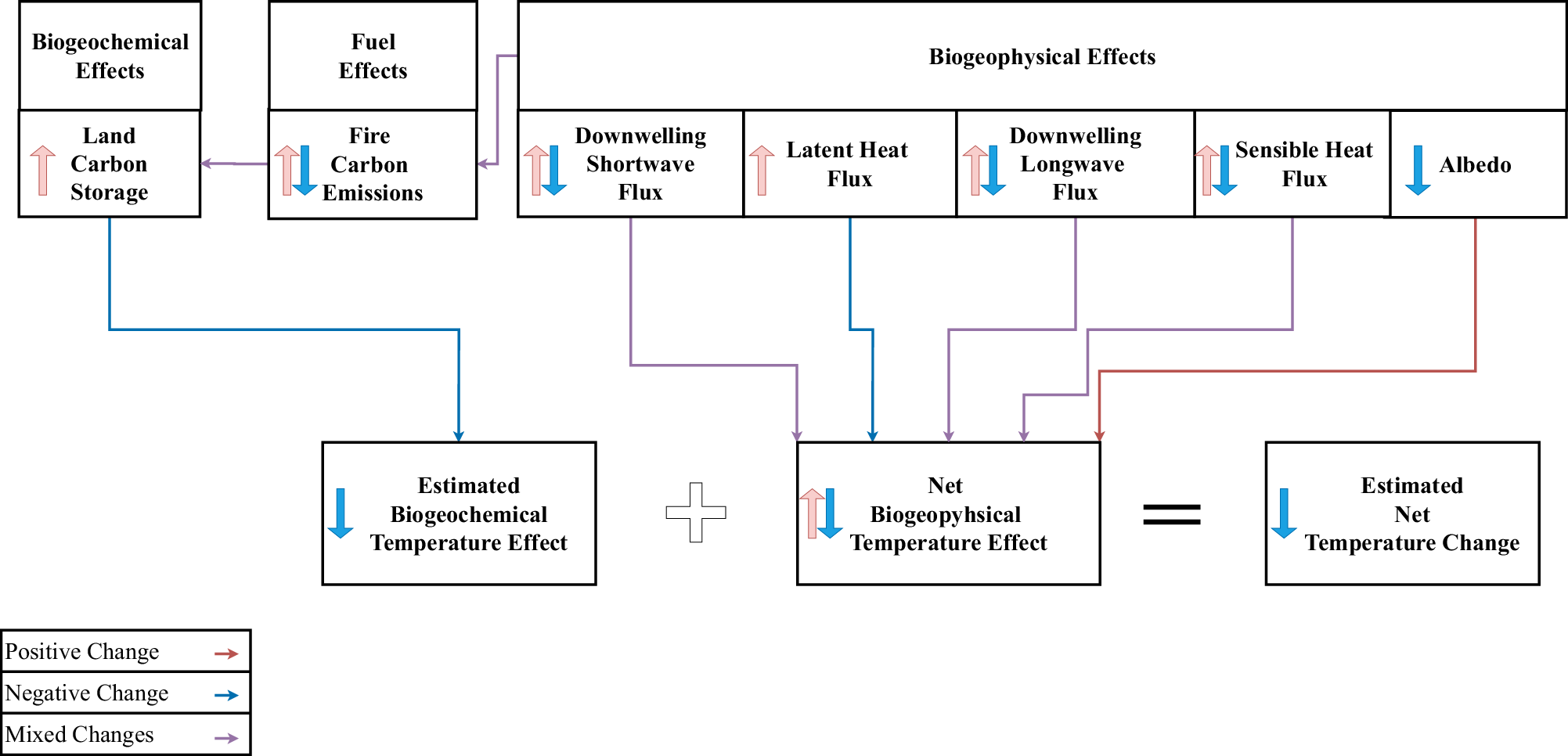
Abstract
Forestation may reduce temperatures by lowering atmospheric CO2. However, biogeophysical changes from forestation may weaken this cooling. We use twelve Coupled Model Intercomparison Project (CMIP6) models to quantify the biogeochemical (carbon cycle) and biogeophysical (non-carbon cycle) effects of net forestation, as quantified as the difference between the end of two future scenarios: ssp370-ssp126Lu and ssp370. Biogeochemical effects have an inferred global multi-model mean cooling (−0.08 ± 0.02 K). Changes in fires have no significant effect on land carbon storage globally. In contrast with studies indicating biogeophysical impacts counteract biogeochemical impacts by up to 50%, we find that biogeophysical effects lead to insignificant global mean cooling (−0.002 ± 0.041 K). Tropical land shows cooling (−0.058 ± 0.058 K) with eight of twelve models indicating cooling, consistent with prior studies. Using the Surface Energy Balance Decomposition, we find cooling is primarily from increased evapotranspiration and decreased downwelling solar radiation related to clouds and aerosols.