2025-08-13 カリフォルニア大学サンタバーバラ校
<関連情報>
- https://news.ucsb.edu/2025/021991/years-after-earthquake-rivers-still-carry-mountains-downstream
- https://www.nature.com/articles/s41586-025-09354-8
地震後10年間持続した大規模な川床堆積物流量 Large riverbed sediment flux sustained for a decade after an earthquake
Gen K. Li,A. Joshua West,Zhangdong Jin,Hongrui Qiu,Fei Zhang,Jin Wang,Douglas E. Hammond,Alexander L. Densmore,Robert G. Hilton,Sijia Dong,Abra Atwood,Woodward W. Fischer & Michael P. Lamb
Nature Published:13 August 2025
DOI:https://doi.org/10.1038/s41586-025-09354-8
Abstract
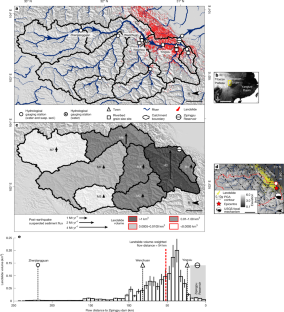
Large earthquakes induce widespread landslides that fill river channels with sediment1,2, generating long-lasting fluvial hazards and reshaping mountain topography. However, riverine sediment fluxes after earthquakes remain poorly resolved, mostly because of a lack of data on bedload flux3,4. Here we construct a source-to-sink sediment budget following the 2008 Mw7.9 (where Mw is the moment magnitude) Wenchuan earthquake in the eastern Tibetan mountains. We measured sediment accumulation in a man-made reservoir downstream of the earthquake-affected region. Ten years after the earthquake, the Min Jiang River had exported about 9% of the sediment mass from earthquake-triggered landslides, with around 5.7 times increase in the total riverine sediment flux sustained over that time. Bedload flux increased by 27.4+14.6-15.6% times compared with pre-earthquake levels, making up 65+12-26% of the post-earthquake sediment export—a proportion much higher than typical of most mountainous rivers. At the current pace, the river system will remove most Wenchuan landslide debris over centennial timescales. However, future sediment export rates are likely to vary because of changes on hillslopes (for example, revegetation) and in hydrology, sediment characteristics and transport processes. Our findings demonstrate a decadal bedload-dominated sediment pulse driven by earthquake-triggered landslides, suggesting that increased vulnerability to cascading hazards such as aggradation and flooding could persist for decades in populated downstream regions after a large earthquake.