
2025-08-12 中国科学院(CAS)
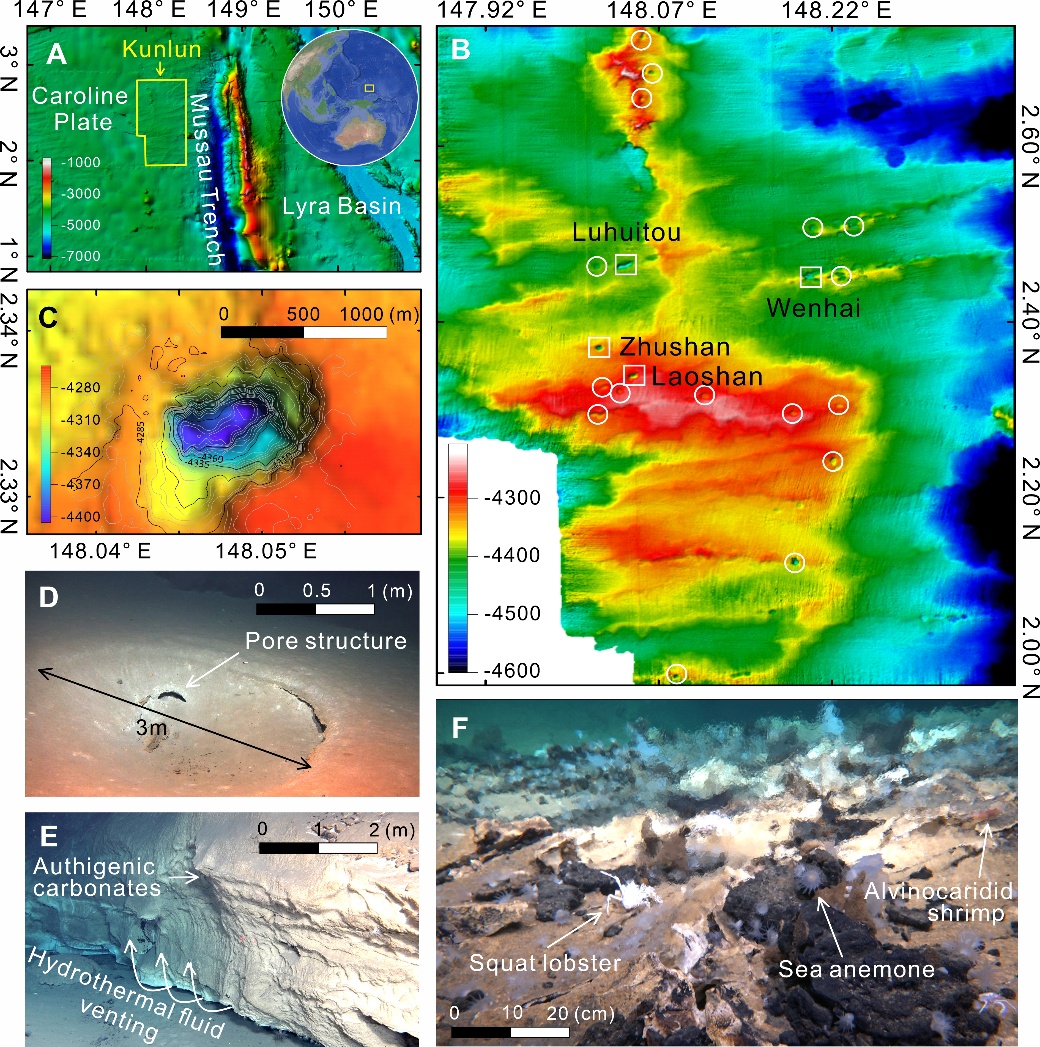
Hydrothermal activities and distribution of pipe swarms on the subducting plate near the Mussau Trench. (Image by IOCAS)
<関連情報>
- https://english.cas.cn/newsroom/research_news/earth/202508/t20250811_1049940.shtml
- https://www.science.org/doi/10.1126/sciadv.adx3202
西太平洋西部における蛇紋岩化に駆動される大規模なプレート内水素豊富熱水系:クンルン A large intraplate hydrogen-rich hydrothermal system driven by serpentinization in the western Pacific: Kunlun
Lianfu Li, Hongyun Zhang, Shichuan Xi, Chenglong Liu, […] , and Weidong Sun
Science Advances Published:8 Aug 2025
DOI:https://doi.org/10.1126/sciadv.adx3202
Abstract
The Kunlun hydrothermal system near the Mussau Trench in the western Pacific consists of 20 large round/oval craters of hundreds of meters in diameter. The total area is 11.1 square kilometers, i.e., over a hundred times larger than the Lost City. Four of the larger craters were prospected using the human occupied vehicle Fendouzhe and have steep walls similar to those of kimberlite pipes, with depths of up to 130 meters. Ecosystems have been observed in smaller pits on the bottom of these pipes. Hydrogen concentrations of ~5.9 to 6.8 millimoles per kilogram in hydrothermal fluids have been obtained using in situ Raman spectra. The estimated total hydrogen flux of Kunlun is 4.8 × 10¹¹ moles per year, which is >5% of the estimated global submarine abiotic hydrogen flux. Hydrogen-rich, alkaline fluids generated by serpentinization have formed large-scale carbonate rocks within the pipes below the carbonate compensation depth, and both dolomite and calcite have been identified.

