<関連情報>
- https://news.umich.edu/biodiversity-matters-in-every-forest-but-even-more-in-wetter-ones/
- https://www.nature.com/articles/s41559-025-02805-5
実験林における近隣の多様性は、湿潤な気候では樹木の成長を促進するが、湿潤な年ではその効果は認められない Neighbourhood diversity increases tree growth in experimental forests more in wetter climates but not in wetter years
Liting Zheng,Inés Ibáñez,Laura J. Williams,Kai Zhu,Hernán Serrano-León,Joel Jensen,Nico Eisenhauer,Kris Verheyen,Michael Scherer-Lorenzen,Florian Schnabel,Holger Kreft,Nathaly R. Guerrero-Ramírez,Dirk Hölscher,Gustavo B. Paterno,Bambang Irawan,Quentin Ponette,Christian Messier,Alain Paquette,Artur Stefanski,Simone Mereu,Jürgen Bauhus,Peter Hajek,Charles A. Nock,Jeannine Cavender-Bares,… Peter B. Reich
Nature Ecology & Evolution Published:25 July 2025
DOI:https://doi.org/10.1038/s41559-025-02805-5
Abstract
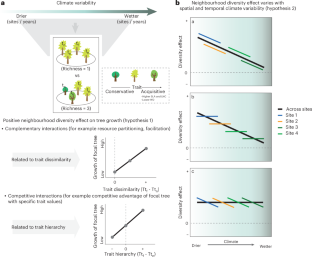
Tree diversity often increases stand-level growth, but whether neighbourhood diversity effects on individual tree growth change with climatic conditions remains unclear. Here, using 852,170 records of 113,701 individuals from 129 species in 15 tree diversity experiments across four biomes, we address this knowledge gap with a synthesis of tree growth data spanning a broad climate gradient. We examine how neighbourhood-scale (defined as a focal tree and the adjacent trees) taxonomic and functional diversity effects on tree growth vary with climate, both spatially (across sites) and temporally (within sites). Increasing species richness and trait dissimilarity from monospecific to high-diversity neighbourhoods enhanced individual tree growth by 7–13% on average. The positive diversity effect increased from dry to wet climates, contrasting with most prior studies, but was unaffected by interannual climatic variation within sites. Given that tree–tree interactions are ubiquitous and likely to interact with climate in both young and old forests, our findings suggest incorporating neighbourhood diversity as a management tool to enhance forest productivity, while considering underlying mechanisms and interactions with climate, thereby facilitating targeted and site-specific climate and biodiversity benefits.