
2025-08-06 中国科学院(CAS)
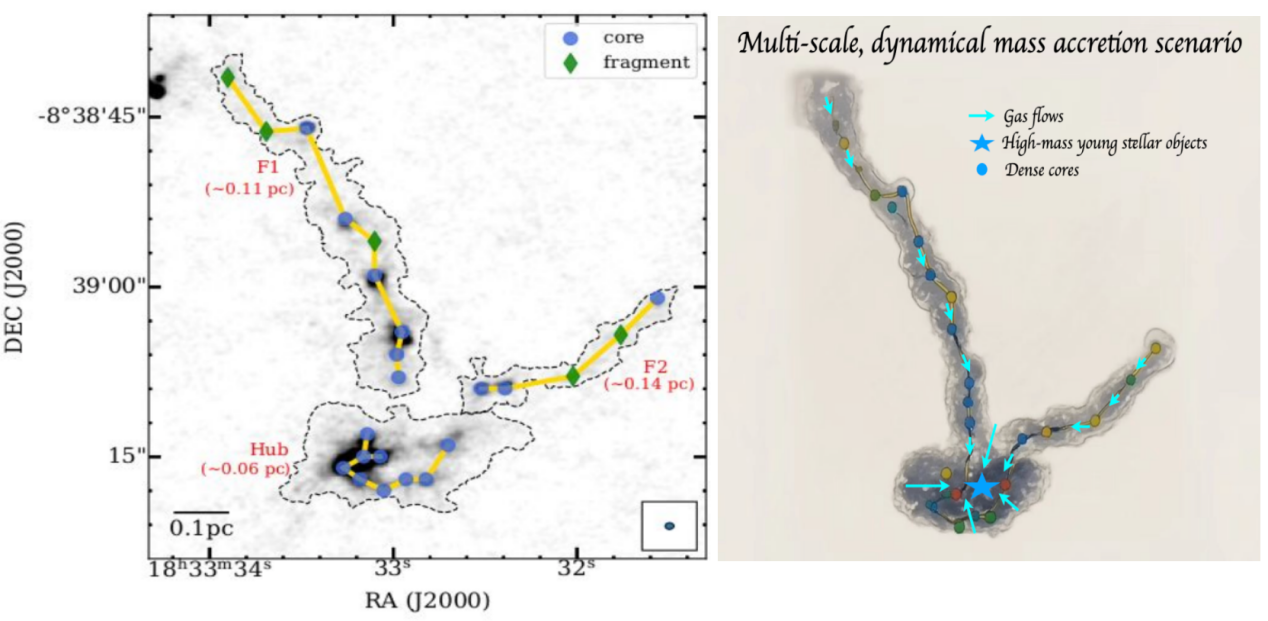
Left: Morphological structure of the HFS in target region I18308, showing core spacing distribution. The HFS molecular cloud consists of two distinct filamentary structures (F1 and F2) and a central hub clump. Right: Artistic illustration of multi-scale dynamic mass accretion. (Image by SHAO)
<関連情報>
- https://english.cas.cn/newsroom/research_news/phys/202508/t20250806_1049253.shtml
- https://www.aanda.org/articles/aa/full_html/2025/08/aa54634-25/aa54634-25.html
INFANT調査の一環として観察されたハブ・フィラメント・システムI18308における階層的断片化 Hierarchical fragmentation in hub-filament-system I18308 observed as part of the INFANT survey
L. M. Zhen, , H.-L. Liu,, X. Lu,, Y. Cheng, R. Galván-Madrid, H. B. Liu, P. Sanhueza, T. Liu,, D. T. Yang, F. Nakamura,,, S. H. Jiao,, L. Chen, Y. Q. Guo, S. Y. Feng, Q. Zhang, X. C. Liu, K. Wang, Q. L. Gu, Q. Y. Luo, Y. Lin, P. S. Li, S. H. Li,, K. Tanaka and A. E. Guzmán
Astronomy & Astrophysics Published:04 August 2025
DOI:https://doi.org/10.1051/0004-6361/202554634
Abstract
Context. There is increasing evidence of a physical link between high-mass star formation and hub-filament systems (HFSs). However, a lack of multi-scale observations of HFS clouds hinders our understanding of the detailed and scale-dependent cloud fragmentation and associated dynamical high-mass star formation.
Aims. This study aims to understand the multi-scale scenario of cloud fragmentation and associated high-mass star formation in an HFS cloud.
Methods. As part of the ALMA-INFANT survey, we used 1.3 mm mosaic observations of the high-mass star-forming HFS cloud I18308 at a spatial resolution of ~3000 AU, which provided multiscale information on the HFS. We analyzed the filament and hub fragmentation properties (e.g., core separation and mass).
Results. The I18308 cloud exhibits a well-defined HFS morphology in ALMA 1.3 mm continuum with two filaments (F1 and F2) converging toward the central hub. Eighteen compact cores are identified: nine in the hub, six in F1, and three in F2. Most cores are gravitationally bound and have high-mass surface densities of >1 g cm-2, indicating their potential for high-mass star formation, especially in the hub, which already hosts an embedded UCH II region. The scale-dependent fragmentation is characterized by a cylindrical mode for F1 and F2, and a nearly-spherical Jeans-like mode for the central clumpy hub. This could be attributed to the (an)isotropic evolution of larger scale density structures into smaller scale ones. Additionally, the scale-dependent fragmentation mechanisms are identified as turbulence-driven within the filaments and gravity-driven inside the central hub. No candidate high-mass prestellar cores (>30 M⊙) are observed across the whole cloud. In the hub, protostellar cores have higher average mass, surface density, and temperature; and smaller radius than prestellar cores, which is consistent with continuous mass accumulation during evolution.
Conclusions. The well-defined HFS morphology, the absence of high-mass prestellar cores, and the increasing core mass and surface density with evolutionary stage collectively suggest a multi-scale dynamical scenario of mass accumulation for high-mass star formation in I18308.


