2025-08-01 カリフォルニア大学バークレー校(UCB)
 <関連情報>
- https://engineering.berkeley.edu/news/2025/08/researchers-develop-energy-efficient-memory-sensor-for-wet-salty-environments/
- https://www.nature.com/articles/s41563-025-02312-9
デバイ長内の表面イオン移動によるMEMSセンシング Memsensing by surface ion migration within Debye length
Ruihan Guo,Qixin Feng,Ke Ma,Gi-Hyeok Lee,Moniruzzaman Jamal,Xiao Zhao,Karen C. Bustillo,Jiawei Wan,Duncan S. Ritchie,Linbo Shan,Yuhang Cai,Jiachen Li,Jack Shen,Kaichen Dong,Ru Huang,Yimao Cai,Feng Wang,Miquel Salmeron,Haimei Zheng,Matthew Sherburne,Mary Scott,Wanli Yang,Mark Asta,Kechao Tang & Junqiao Wu
Nature Materials Published:01 August 2025
DOI:https://doi.org/10.1038/s41563-025-02312-9
Abstract
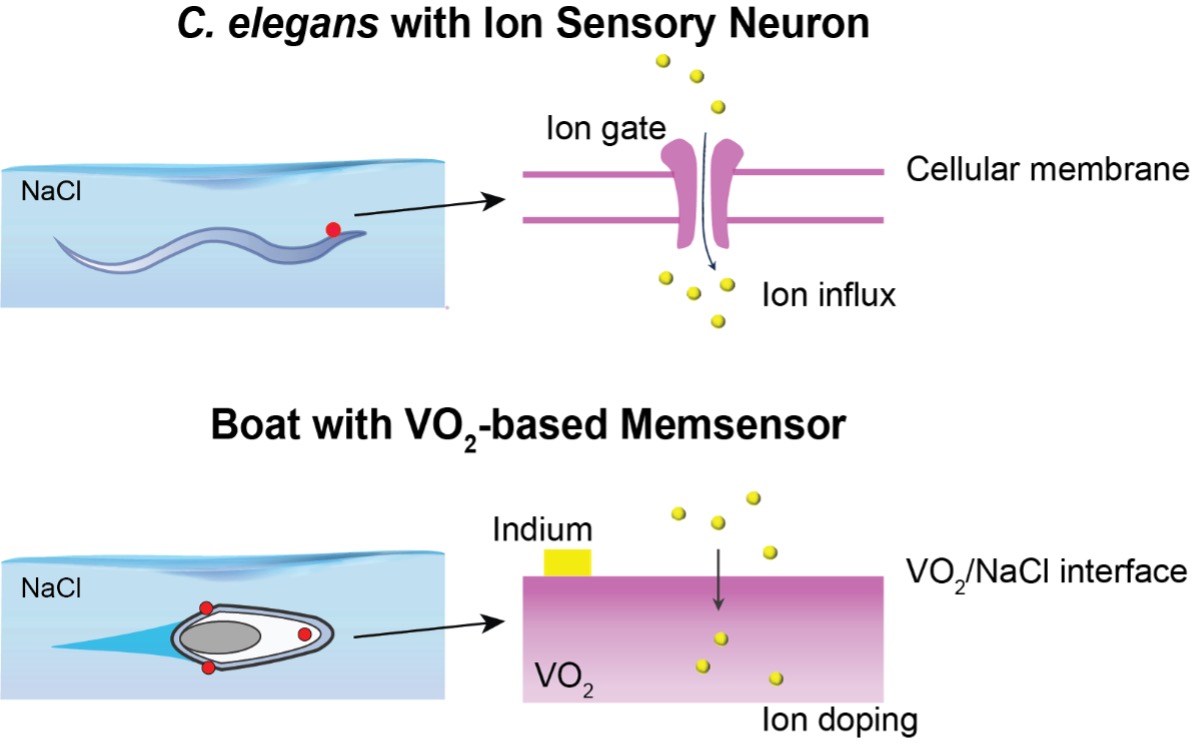
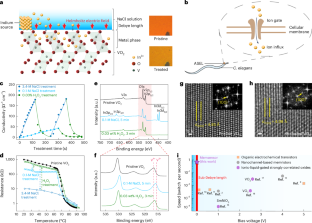
Integration between electronics and biology is often facilitated by iontronics, where ion migration in aqueous media governs sensing and memory. However, the Debye screening effect limits electric fields to the Debye length, the distance over which mobile ions screen electrostatic interactions, necessitating external voltages that constrain the operation speed and device design. Here we report a high-speed in-memory sensor based on vanadium dioxide (VO2) that operates without an external voltage by leveraging built-in electric fields within the Debye length. When VO2 contacts a low-work-function metal (for example, indium) in a salt solution, electrochemical reactions generate indium ions that migrate into the VO2 surface under the native electric field, inducing a surface insulator-to-metal phase transition of VO2. The VO2 conductance increase rate reflects the salt concentration, enabling in-memory sensing, or memsensing of the solution. The memsensor mimics Caenorhabditis elegans chemosensory plasticity to guide a miniature boat for adaptive chemotaxis, illustrating low-power aquatic neurorobotics with fewer memory units.