2025-08-05 シンガポール国立大学(NUS)
ChatGPT:
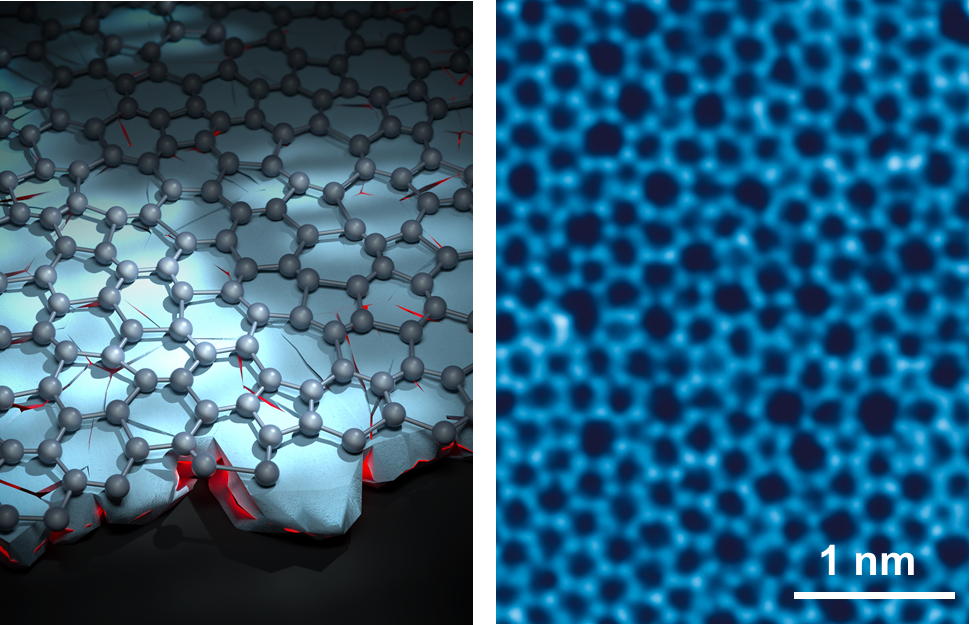
A schematic illustration for disorder-to-disorder synthesis (left) and an atomic-resolution scanning transmission electron microscopy image of UC-MAC (right).
<関連情報>
- https://news.nus.edu.sg/new-material-sharpens-proton-beams-boosting-cancer-treatment/
- https://www.nature.com/articles/s41565-025-01968-3
超純粋な単層非晶質炭素が高精度プロトンビームを生成 Ultraclean monolayer amorphous carbon yields a high-precision proton beam
Huihui Lin,Jian Jiang,Yanxin Dou,Pin Lyu,Xiaocang Han,Yuan Meng,Yuanyuan He,Xin Zhou,Kangshu Li,Guoming Lin,Yu Teng,Jinxing Chen,Yang Meng,Thomas Osipowicz,Xiaoxu Zhao,Xiao Cheng Zeng & Jiong Lu
Nature Nanotechnology Published:28 July 2025
DOI:https://doi.org/10.1038/s41565-025-01968-3
Abstract
Ångström-scale polygonal rings in monolayer amorphous carbon (MAC) enhance its electronic and mechanical properties while providing unique ångström pores for precise subatomic species separation, essential for advancements in catalysis, energy and medicine. However, the absence of an industrial-scale synthesis method for intrinsic MAC has limited its technological applications compared with graphene and bulk amorphous materials. Herein, we report an industry-compatible disorder-to-disorder synthesis approach to achieve wafer-scale ultraclean MAC (UC-MAC) within a timescale of seconds, featuring optimized ångström polygons without detectable metal contamination, and nanosized pores. In contrast to metal-contaminated MAC, UC-MAC allows atomic-scale characterization of intrinsic electronic properties and functions as an ångström-scale membrane, facilitating the splitting of high-flux H2+ ions into a high-precision proton beam with minimal detrimental fragment-proton scattering events, about half and 40 times less than those from single-crystal graphene and commercial carbon thin films, respectively. The minimum possible membrane material thickness that can yield a highly sharpened proton beam with accurately modulated beam current is desired for proton therapy.