2025-08-04 中国科学院(CAS)
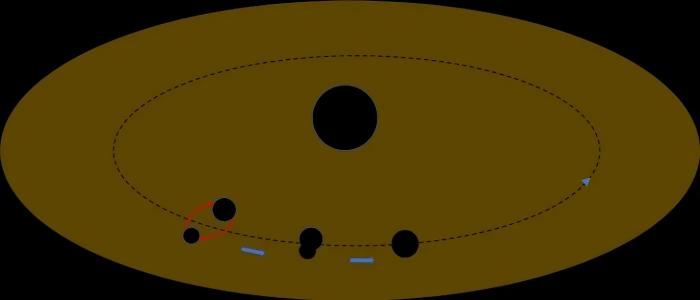
Binary black holes merge near a supermassive black hole. (Photo from Shanghai Astronomical Observatory)
<関連情報>
- https://english.cas.cn/newsroom/cas_media/202508/t20250804_1048984.shtml
- https://iopscience.iop.org/article/10.3847/2041-8213/adeaad
LIGO–Virgoの二連ブラックホール合併の近くにあるコンパクト天体の検出 Indication for a Compact Object Next to a LIGO–Virgo Binary Black Hole Merger
Shu-Cheng Yang, Wen-Biao Han, Hiromichi Tagawa, Song Li, and Chen Zhang
The Astrophysical Journal Letters Published: 2025 July 21
DOI:10.3847/2041-8213/adeaad
Abstract
The astrophysical origin of binary black hole (BBH) mergers remains uncertain, although many events have been observed by the LIGO–Virgo–KAGRA network. Such mergers are potentially originated in the vicinity of massive black holes (MBHs). GW190814, due to its secondary mass and mass ratio being beyond the expectations of isolated stellar evolution theories, is a promising event that has occurred in an active galactic nucleus (AGN) disk. In this model, a compact object resides in the vicinity of a merging BBH. Here we report multiple pieces of evidence suggesting that GW190814 is a BBH merging near a compact object. The orbital motion of BBHs around a third body produces a line-of-sight acceleration (LSA) and induces a varying Doppler shift. Using a waveform template that considers LSA, we perform Bayesian inference on a few BBH events with a high signal-to-noise ratio in the gravitational-wave (GW) transient catalog. Compared to the model for isolated BBH mergers, we obtain significantly higher network signal-to-noise ratios for GW190814 with the inclusion of LSA, constraining the LSA to a=0.0015+0.0008-0.0008cs-1 at a 90% confidence level. Additionally, the Bayes factor for the LSA case over the isolated case is 58/1, indicating that the LSA model is strongly preferred by the GW data. We conclude that this is the first indication showing merging BBHs are located near a third compact object.