2025-07-30 中国科学院(CAS)
<関連情報>
- https://english.cas.cn/newsroom/research_news/earth/202507/t20250731_1048805.shtml
- https://www.nature.com/articles/s41467-025-62262-3
OsBZR4はイネの温度依存性胚発生を調節する OsBZR4 regulates temperature-dependent embryogenesis in rice
Zhenyu Wang,Min Xu,Yingxiang Liu,Xiaoming Zheng,Zhipeng Hong,Mingliang He,Xin Jin,Jiaqi Tang,Xiufeng Li,Xiaojie Tian,Qian Qian & Qingyun Bu
Nature Communications Published:26 July 2025
DOI:https://doi.org/10.1038/s41467-025-62262-3
Abstract
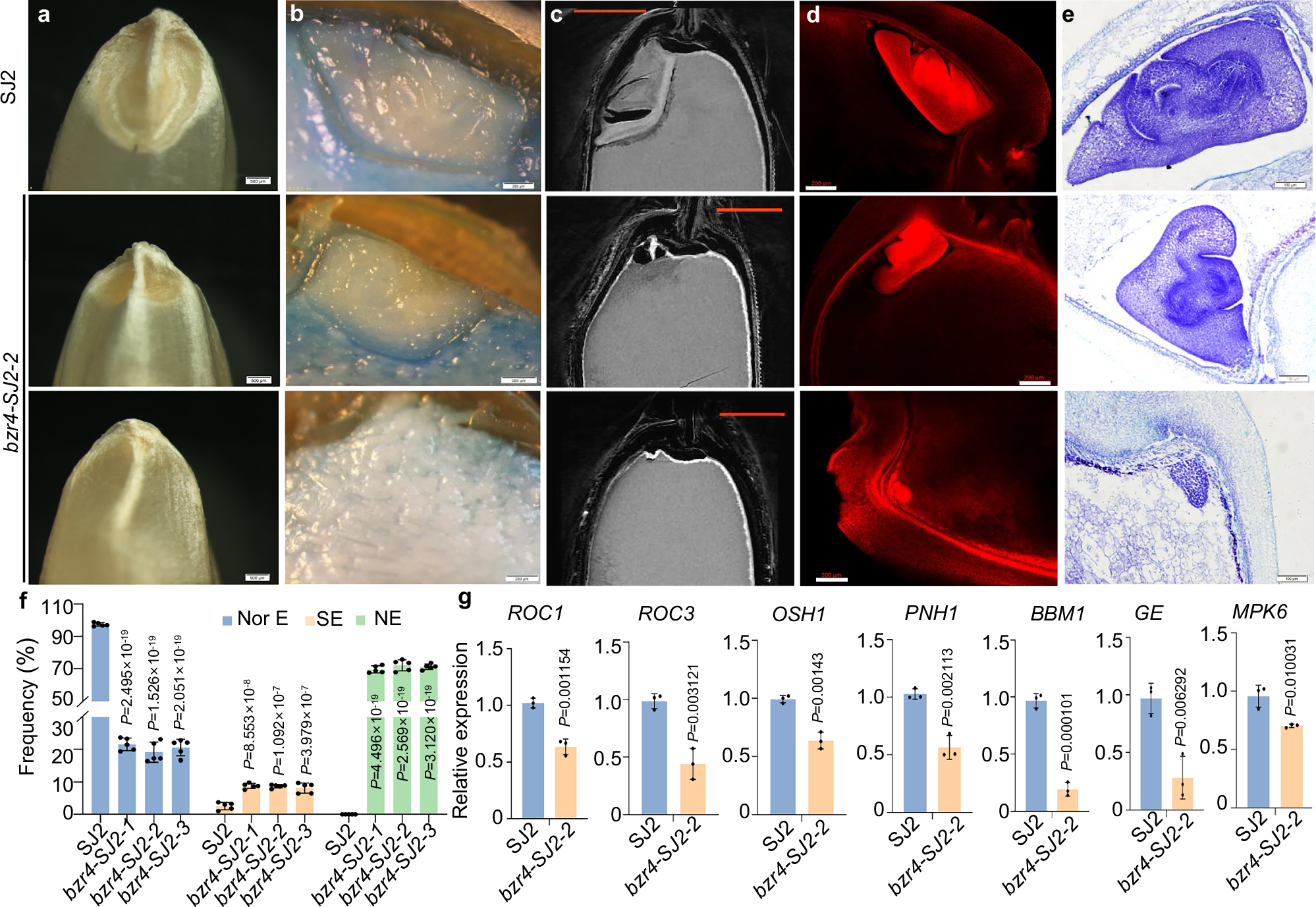
Embryoless rice is valuable for studying early seed development and has great breeding potential, however, related research remains limited. Here, we show that mutations in OsBZR4, encoding brassinazole-resistance 4, lead to 60–100% embryoless seeds across different cultivars. OsBZR4 is specifically expressed at the scutellum-endosperm interface and regulates auxin levels and distribution during early embryo development. OsBZR4 represses the expression of YUC4 and PIN5b. Exogenous auxin and overexpression of YUC4 enhance the embryoless ratio, whereas the auxin transport inhibitor N-1-naphthylphthalamic acid (NPA) decrease it. Higher temperatures increase the embryoless ratio in bzr4 mutant lines. The expression of OsPIL13 is induced by high temperature, and its overexpression enhances the embryoless ratio in both wild type and bzr4 plants. Introducing bzr4 mutant allele into some elite cultivars can improve milled rice yield and storability. Collectively, manipulating OsBZR4 can lead to the development of thermosensitive embryoless rice varieties with increased energy reserves and improved storability, potentially enabling novel rice production technologies.