
2025-07-31 京都大学
<関連情報>
- https://www.kyoto-u.ac.jp/ja/research-news/2025-07-31
- https://www.kyoto-u.ac.jp/sites/default/files/2025-07/web_2507_Ebihara-899dad1dde50f03dd7d1930de3ee9eb8.pdf
- https://agupubs.onlinelibrary.wiley.com/doi/full/10.1029/2025JA033731
地球の磁気圏における準定常的な夜明けから日没までの対流電気場に関するMHDシミュレーション研究 MHD Simulation Study on Quasi-Steady Dawn-Dusk Convection Electric Field in Earth’s Magnetosphere
Yusuke Ebihara, Masafumi Hirahara, Takashi Tanaka
Journal of Geophysical Research: Space Physics Published: 10 July 2025
DOI:https://doi.org/10.1029/2025JA033731
Abstract
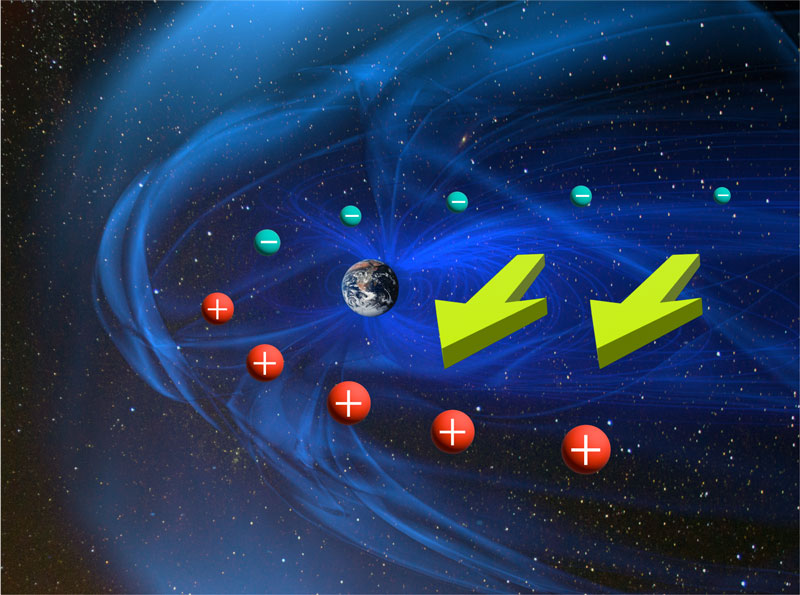
We investigated the large-scale, quasi-steady magnetospheric electric field by using global magnetohydrodynamic (MHD) simulations. When a southward interplanetary magnetic field was imposed, a large-scale, dawn-dusk electric field appeared in the magnetosphere. The dawn-dusk electric field on the dayside is quasi-steady, and can be approximately represented by a scalar potential, that is, an electrostatic field. However, the positive space charge dominates the duskside magnetosphere, while the negative space charge dominates the dawnside magnetosphere. The results suggest the following. (a) At least in the global MHD simulation, space charge accumulation in the magnetosphere alone cannot fully account for the dawn-dusk electric field. Instead, plasma motion plays a primary role in generating the dawn-dusk electric field as previously suggested. (b) Steady convection electric field can be established when plasma flow remains steady. Even under such steady conditions, magnetic energy is continuously transferred from the solar wind to the polar ionosphere, as manifested by integral curves of the Poynting flux vector. This unidirectional energy flow is associated with the convective plasma motion that produces the steady dawn-dusk electric field. (c) Despite the electric field being steady, dynamical processes persist within the magnetosphere. It is also suggested that the magnetosphere basically maintains dynamic equilibrium through a balance of unidirectional energy flow from the solar wind to the ionosphere. When dynamic equilibrium is partially disrupted, the electric field becomes inductive. For the large-scale convection electric field, whether the electric field is electrostatic or inductive depends on the state of dynamic equilibrium.
Key Points
- For the southward interplanetary magnetic field (IMF), dawn-dusk electric field appears in the magnetosphere, while positive (negative) charge largely occupies the duskside (dawnside)
- The dawn-dusk electric field in the magnetosphere results from plasma motion (−V × B), not from space charge deposited in the magnetosphere
- A steady electric field can develop when the plasma flow remains steady, implying dynamic equilibrium through a balance of energy flow
Plain Language Summary
The Earth’s magnetosphere acts as a protective shield against the solar wind—a stream of charged particles from the Sun. This interaction results in a large-scale electric field in the magnetosphere, known as a dawn-dusk convection electric field, playing a crucial role in disturbances such as the storm-time ring current and substorms. We explored the quasi-steady large-scale electric fields and the role of space charge in the magnetosphere by using global magnetohydrodynamics (MHD) simulations. When the interplanetary magnetic field is southward, a substorm growth phase begins. The large-scale electric field is in a relatively stable condition, in particular, on the dayside. In the MHD simulation, the positive space charge dominates the duskside magnetosphere, while the negative space charge dominates the dawnside. If the electric field is purely caused by the space charge deposited in the magnetosphere, the direction of the electric field will be in the dusk-dawn direction. However, the dawn-dusk electric field is established in the magnetosphere due to continued plasma motion interacting with the magnetic field. It is suggested that the magnetosphere maintains dynamic equilibrium through a balance of energy flow from the solar wind to the ionosphere. These insights improve our understanding of magnetospheric convection and the magnetospheric system.


