2025-07-24 東京大学
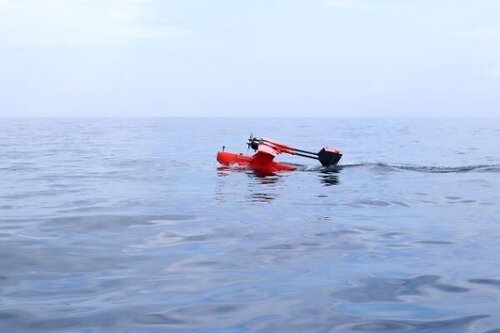
海面を移動するUAV
<関連情報>
- https://www.iis.u-tokyo.ac.jp/ja/news/4826/
- https://agupubs.onlinelibrary.wiley.com/doi/10.1029/2025EA004237
水上飛行機型UAVを基盤とした高精度GNSS-A海底地殻変形観測システムの構築と実証 Construction and Demonstration of a Seaplane-Type UAV-Based High-Precision GNSS-A Seafloor Crustal Deformation Observation System
Y. Yoshizumi, Y. Yokota, M. Kaneda, S. Yamaura, Y. Kameta, T. Inoue, K. Kouno
Earth and Space Science Published: 23 July 2025
DOI:https://doi.org/10.1029/2025EA004237
Abstract
The Global Navigation Satellite System—Acoustic combination (GNSS-A) is used to observe seafloor crustal deformation by determining the global position of the seafloor with GNSS positioning and acoustic ranging between a sea surface platform and a transponder station located on the seafloor. However, GNSS-A observations are currently conducted mainly by vessels, and economic and physical constraints limit the ability to improve the frequency and real-time nature of observations. Therefore, unmanned arial vehicle (UAV) -based GNSS-A observation has been proposed. In this study, we constructed a GNSS-A system based on a seaplane-type UAV capable of centimeter-level measurements and evaluated its seafloor positioning performance. An experiment in a tank showed that the system has an acoustic ranging accuracy of less than 2.1 cm, and allowed us to evaluate the previously unreported fractional wavelength instrumental biases. UAV-based GNSS-A tests were conducted using the constructed system at an actual GNSS-A site. Under optimal sea conditions devoid of significant waves or wind, the observation result suggested that seafloor positioning could be achieved with a horizontal RMS of approximately 1–2 cm—comparable to that of vessel-based systems. Thus, we established the foundations for practical UAV observation technology for the operation of high-frequency observations and emergency observations for detecting postseismic deformation. It has also become possible to verify instrument bias in a vessel-based system.
Key Points
- We constructed a centimeter-level seafloor geodetic observation system using a seaplane-type drone and evaluated its performance
- The preliminary and at-sea trial tests demonstrated the precision of the constructed unmanned arial vehicle observation technology
- Building a system that does not need a ship enables high-frequency observations and is also effective in verifying accuracy