2025-07-24 ワシントン大学
<関連情報>
- https://www.washington.edu/news/2025/07/24/seismologists-use-fiber-optic-cables-to-study-offshore-faults/
- https://pubs.geoscienceworld.org/ssa/srl/article/96/2A/784/652443/Multiplexed-Distributed-Acoustic-Sensing-Offshore
- https://agupubs.onlinelibrary.wiley.com/doi/abs/10.1029/2024JB029728
中央オレゴン沖でのマルチプレックス分散型音響センシング Multiplexed Distributed Acoustic Sensing Offshore Central Oregon
Qibin Shi;Ethan F. Williams;Bradley P. Lipovsky;Marine A. Denolle;William S. D. Wilcock;Deborah S. Kelley;Katelyn Schoedl
Seismological Research Letters Published:February 28, 2025
DOI:https://doi.org/10.1785/0220240460
Abstract
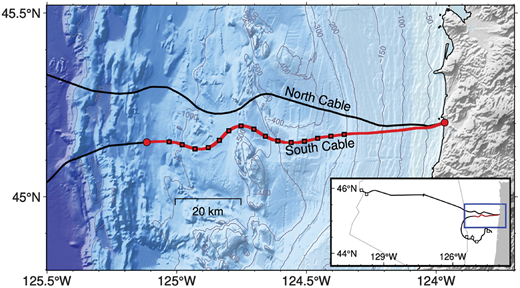
Distributed acoustic sensing (DAS) on submarine fiber‐optic cables is providing new observational insights into solid Earth processes and ocean dynamics. However, the availability of offshore dark fibers for long‐term deployment remains limited. Simultaneous telecommunication and DAS operating at different wavelengths in the same fiber, termed optical multiplexing, offers one solution. In May 2024, we collected a four‐day DAS dataset utilizing an L‐band DAS interrogator and multiplexing on the submarine cables of the Ocean Observatory Initiative’s Regional Cabled Array offshore central Oregon. Our findings show that multiplexed DAS has no impact on communications and is unaffected by network traffic. Moreover, the quality of DAS data collected via multiplexing matches that of data obtained from dark fiber. With a machine‐learning event detection workflow, we detect 31 T waves and the S wave of one regional earthquake, demonstrating the feasibility of continuous earthquake monitoring using the multiplexed offshore DAS. We also examine ocean waves and ocean‐generated seismic noise. We note high‐frequency seismic noise modulated by low‐frequency ocean swell and hypothesize about its origins. The complete dataset is freely available.
マスク付きオートエンコーダーを用いた中央オレゴン沖の分散型音響センシングのノイズ除去による地震検出の向上 Denoising Offshore Distributed Acoustic Sensing Using Masked Auto-Encoders to Enhance Earthquake Detection
Qibin Shi, Marine A. Denolle, Yiyu Ni, Ethan F. Williams, Nan You
Journal of Geophysical Research: Solid Earth Published: 20 February 2025
DOI:https://doi.org/10.1029/2024JB029728
Abstract
Offshore distributed acoustic sensing (DAS) has emerged as a powerful technology for seismic monitoring, expanding the capacities of cable networks and coastal seismic networks to monitor offshore seismicity. However, offshore DAS data often combine signals unfamiliar to seismologists, including new types of instrumental noise and ocean signals that overprint those from tectonic sources, which may hinder seismological research. We develop a self-supervised deep learning algorithm, a masked auto-encoder (MAE), to denoise DAS data for seismological purposes. The model is trained on DAS recordings of local earthquakes with randomly masked channels acquired on fiber-optic cables in the Cook Inlet offshore Alaska. To demonstrate the benefits of denoising for seismological research, we conduct the most fundamental steps to build any earthquake catalog: seismic phase picking, signal-to-noise ratio (SNR) estimation, and event association. We leverage the generalizability of ensemble deep learning models with cross-correlation to predict phase picks with sufficient precision for post-processing (e.g., earthquake location). The SNR of the denoised S waves of testing DAS data increased by 2.5 dB on average. The MAE denoised, on average, DAS data allows 2.7 times more S picks than the original noisy data for smaller regional earthquakes. The results demonstrate that our self-supervised MAE can elevate the accuracy and efficiency of seismic monitoring with higher earthquake detectability.
Key Points
- Offshore distributed acoustic sensing data is complex, with overlapping signals from the ocean, the solid Earth, and instrumental noise
- A self-supervised masked auto-encoder denoising algorithm doubles the signal-to-noise of earthquake signals
- Denoised signals enable a precise, machine-learning-aided seismic phase picking that improves small earthquake characterization
Plain Language Summary
Distributed acoustic sensing (DAS) is a new technology that can record seismic signals along fiber-optic telecommunication cables, and it is a revolution for offshore earthquake monitoring. However, the data collected can be difficult for seismologists to analyze because it includes many new signals originating from ocean dynamics and tectonic phenomena, along with new kinds of instrumental effects. To improve earthquake analysis, we develop a machine learning denoising algorithm that learns from the data itself as a self-supervised deep learning model. Our method is developed and deployed in the context of earthquake detection and characterization, and we demonstrate the improved signal quality and recovery of important seismic waves in data collected offshore Cook Inlet, Alaska. With the rapid execution of deep learning methods, our approach can benefit near real-time earthquake monitoring.