2025-07-24 パシフィック・ノースウェスト国立研究所(PNNL)
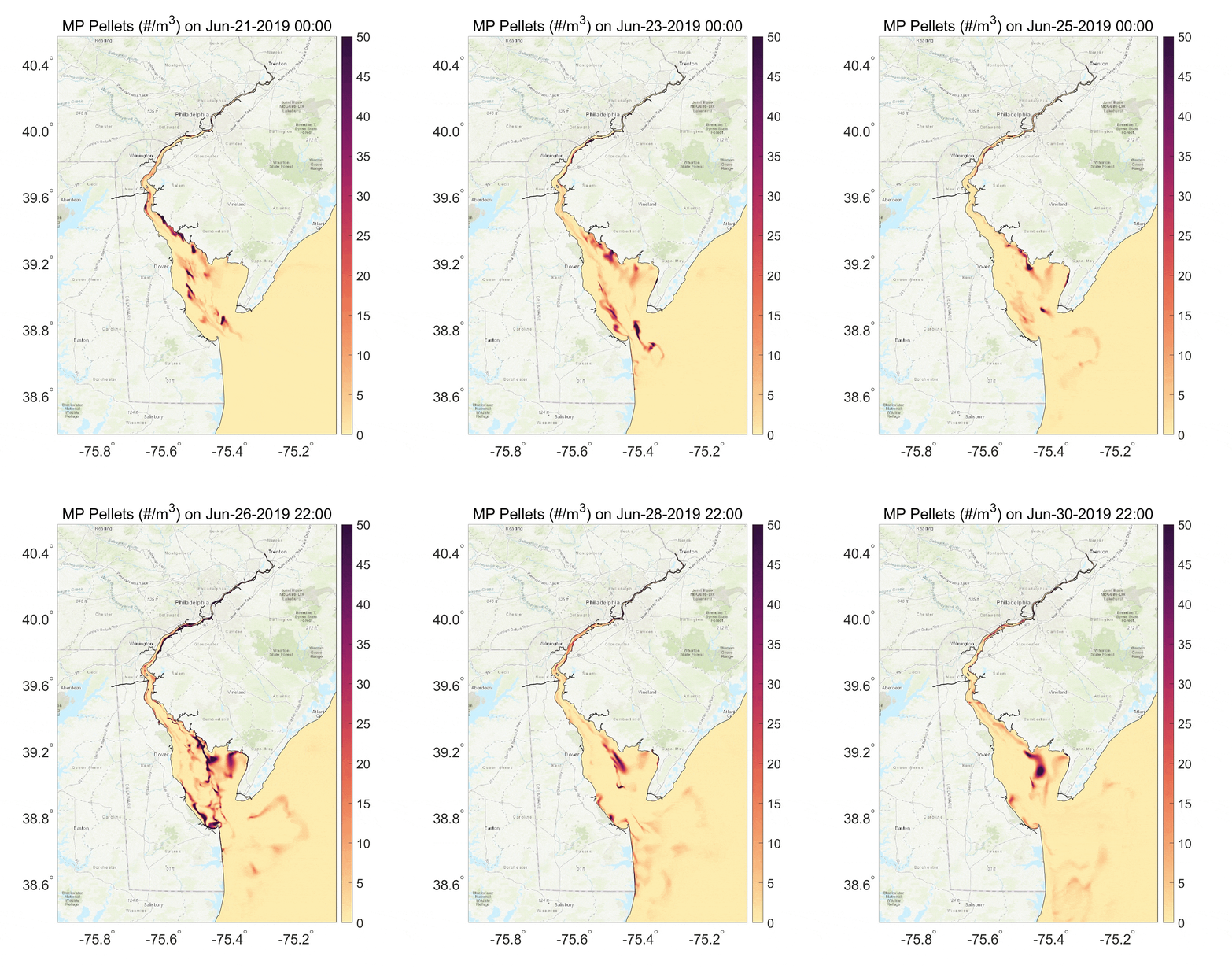
This animation shows how the model predicts movements of particles based on measurements of current and water movement. (Animation by Yicheng Huang | Pacific Northwest National Laboratory)
<関連情報>
- https://www.pnnl.gov/publications/how-do-particles-move-through-rivers-coasts
- https://www.sciencedirect.com/science/article/abs/pii/S0025326X25005491
- https://www.sciencedirect.com/science/article/abs/pii/S0025326X24004387
デラウェア川河口沿いのマイクロプラスチックの分布のモデリング:蓄積パターンと流体力学的影響 Modeling the microplastic distribution along the Delaware River Estuary: Accumulation patterns and hydrodynamic influences
Y. Huang, Z. Yang, T. Wang, J. Liu, N. Sun, Z. Duan, M. Wigmosta, B. Maurer
Marine Pollution Bulletin Available online: 13 May 2025
DOI:https://doi.org/10.1016/j.marpolbul.2025.118074
Highlights
- Models show a sinking microplastic hot spot near the Delaware estuary salinity front.
- Rising MP models show a hot spot upstream of Philadelphia, down-stream of Trenton.
- Hot spots form at tidal speed minima and shift with the salinity front seasonally.
- Strong tidal excursions contribute to the spreading of MP accumulation hot spots.
Abstract
Microplastic pollution is an escalating environmental concern, particularly in densely populated estuary regions, where it poses significant threats to aquatic life and human health. The dispersion patterns of microplastic particles along estuaries are influenced and complicated by multiple environmental factors such as river flow, tidal mixing, salt intrusion, and estuarine circulation. This study examines the accumulation and dispersion patterns by modeling three typical classes of microplastics in the Delaware River Estuary: synthetic fibers, sinking plastic films, and rising plastic pellets. Our findings reveal specific areas with high microplastic accumulation for each type. Notably, the upper estuary regions exhibit significant retention of rising microplastics, associated with a region with reduced along-thalweg velocities downstream of Trenton, NJ and upstream of Philadelphia, PA. Conversely, synthetic fibers and sinking plastic films accumulate in the flow convergence zone near the bottom salinity front, typically downstream of Philadelphia. All of the microplastic accumulation hot spot locations are controlled by the balance of river discharge and salinity intrusions. During the dry season, microplastic accumulation hot spots shift upstream in the estuary, whereas in the wet season, the strong river discharge pushes them downstream. On the other hand, tidal mixing, settling, and resuspension processes strongly impact the spreading of microplastics along the river.
マイクロプラスチックの輸送モードに対するサイズ、形状、密度の影響の定量化:モデリングアプローチ Quantifying the influence of size, shape, and density of microplastics on their transport modes: A modeling approach
Y. Huang, Z. Yang, T. Wang N. Sun, Z. Duan, M. Wigmosta, B. Maurer
Marine Pollution Bulletin Available online: 15 May 2024
DOI:https://doi.org/10.1016/j.marpolbul.2024.116461
Highlights
- We integrated a novel concentration-based MP transport module into FVCOM.
- Impact of MP size, shape, and density on vertical profile is accurately captured.
- We classified the MP transport mode based on the modeled MP profiles.
Abstract
Microplastics (MPs) pose significant risks to marine ecosystems and human health, necessitating accurate predictions of their distributions in aquatic environments for effective risk mitigation. However, understanding MP transport dynamics is challenging because of the inadequate representation of MP characteristics such as size, shape, and density in numerical models. Further, the accuracy of the MP vertical profiles in existing models has not been thoroughly validated. Thus, we developed an MP transport model within the Finite Volume Community Ocean Model framework (FVCOM-MP) by integrating MP characteristics. We validated FVCOM-MP against experimental and analytical data, focusing on various MP transport modes and transitions. FVCOM-MP successfully replicates MP profiles in different transport modes, including the bedload, surface load, suspended load, and mixed load modes. Additionally, we introduce phase diagrams for classifying MP transport modes based on particle characteristics, enhancing our understanding of MP dynamics in aquatic systems. The transport modes for a number of real-world MP particles, including fishing line, plastic bag/bottle fragments, synthetic fibers, tire wear particles, polyvinyl chloride and expanded polystyrene pellets, were analyzed with these phase diagrams.