
ローレンスリバモア国立研究所(LLNL)
<関連情報>
- https://www.llnl.gov/article/53136/deep-learning-model-predicts-how-toxic-plumes-move-through-cities
- https://academic.oup.com/pnasnexus/article/4/6/pgaf198/8169444?login=false
ディープラーニングによる都市有毒プルームの時空間予測 Spatiotemporal predictions of toxic urban plumes using deep learning
Yinan Wang , M Giselle Fernández-Godino , Nipun Gunawardena , Donald D Lucas , Xiaowei Yue
PNAS Nexus Published::19 June 2025
DOI:https://doi.org/10.1093/pnasnexus/pgaf198
Abstract
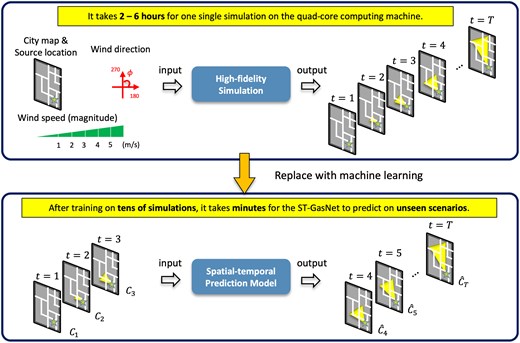
Industrial accidents, chemical spills, and structural fires can release large amounts of harmful materials that disperse into urban atmospheres and impact populated areas. Computer models are typically used to predict the transport of toxic plumes by solving fluid dynamical equations. However, these models can be computationally expensive due to the need for many grid cells to simulate turbulent flow and resolve individual buildings and streets. In emergency response situations, alternative methods are needed that can run quickly and adequately capture important spatiotemporal features. Here, we present a novel deep learning model called ST-GasNet inspired by the mathematical equations that govern the behavior of plumes as they disperse through the atmosphere. ST-GasNet learns the spatiotemporal dependencies from a limited set of temporal sequences of ground-level toxic urban plumes generated by a high-resolution large eddy simulation model. On independent sequences, ST-GasNet accurately predicts the late-time spatiotemporal evolution, given the early-time behavior as an input, even when a building splits a large plume into smaller plumes. By incorporating large-scale wind boundary condition information, ST-GasNet achieves a prediction accuracy of at least 90% on test data for the entire prediction period.


