2025-07-16 森林総合研究所
<関連情報>
- https://www.ffpri.go.jp/press/2025/20250716/index.html
- https://www.ffpri.go.jp/press/2025/20250716/documents/20250716press.pdf
- https://link.springer.com/article/10.1007/s10021-025-00970-z
土壌微生物戦略の解読: リン酸化酵素の質より量を優先する Decoding a Soil Microbial Strategy: Prioritizing Quantity Over Quality of Phosphatases
Taiki Mori,Senhao Wang,Wei Zhang & Jiangming Mo
Ecosystems Published:24 April 2025
DOI:https://doi.org/10.1007/s10021-025-00970-z
Abstract
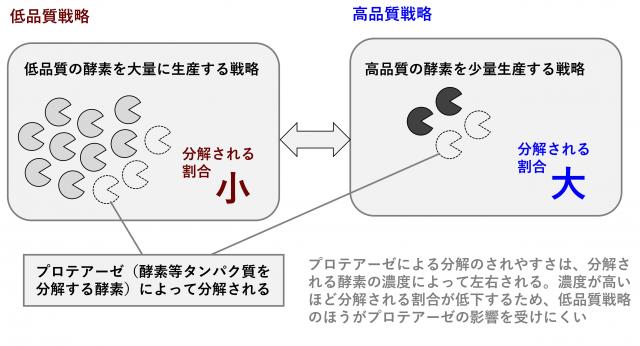
It is widely recognized that soil microorganisms undergo adaptation in response to phosphorus (P)-depleted tropical soils by enhancing the abundance of phosphatases, as evidenced by an increase in the maximum rate of substrate conversion (Vmax) of an assemblage of phosphatases. Conversely, the question remained unclear as to whether soil microorganisms adapt to P-poor conditions by producing “high-quality” enzymes, characterized by an increased affinity in the produced phosphatases, as indicated by a lower Michaelis constant (Km). Through an integrated analysis that encompasses both previously published data from 10-year P-fertilized forests and newly acquired data from a eucalyptus-dominated planted forest in a 6-year P-fertilized forest, we have demonstrated that soil microorganisms adapt to P-deficient conditions by increasing Vmax, rather than by producing high-quality phosphatases (phosphomonoesterases). In response to this, we have proposed a novel hypothesis, termed “the enzyme degradation hypothesis,” which effectively elucidates why microorganisms prioritize quantity over quality of phosphatases. Producing a small quantity of high-quality phosphatases is less advantageous, as proteolytic degradation has a greater impact in this strategy compared to producing a large quantity of low-quality phosphatases. This is because, as the availability of phosphatases—the substrate for proteases—decreases, the proportion of degraded phosphatases relative to the total phosphatase pool increases, due to the upward convexity of the enzyme reaction described by the Michaelis–Menten equation. This hypothesis requires further validation in other forest ecosystems, including different types of tropical forests.