2025-06-24 東京科学大学
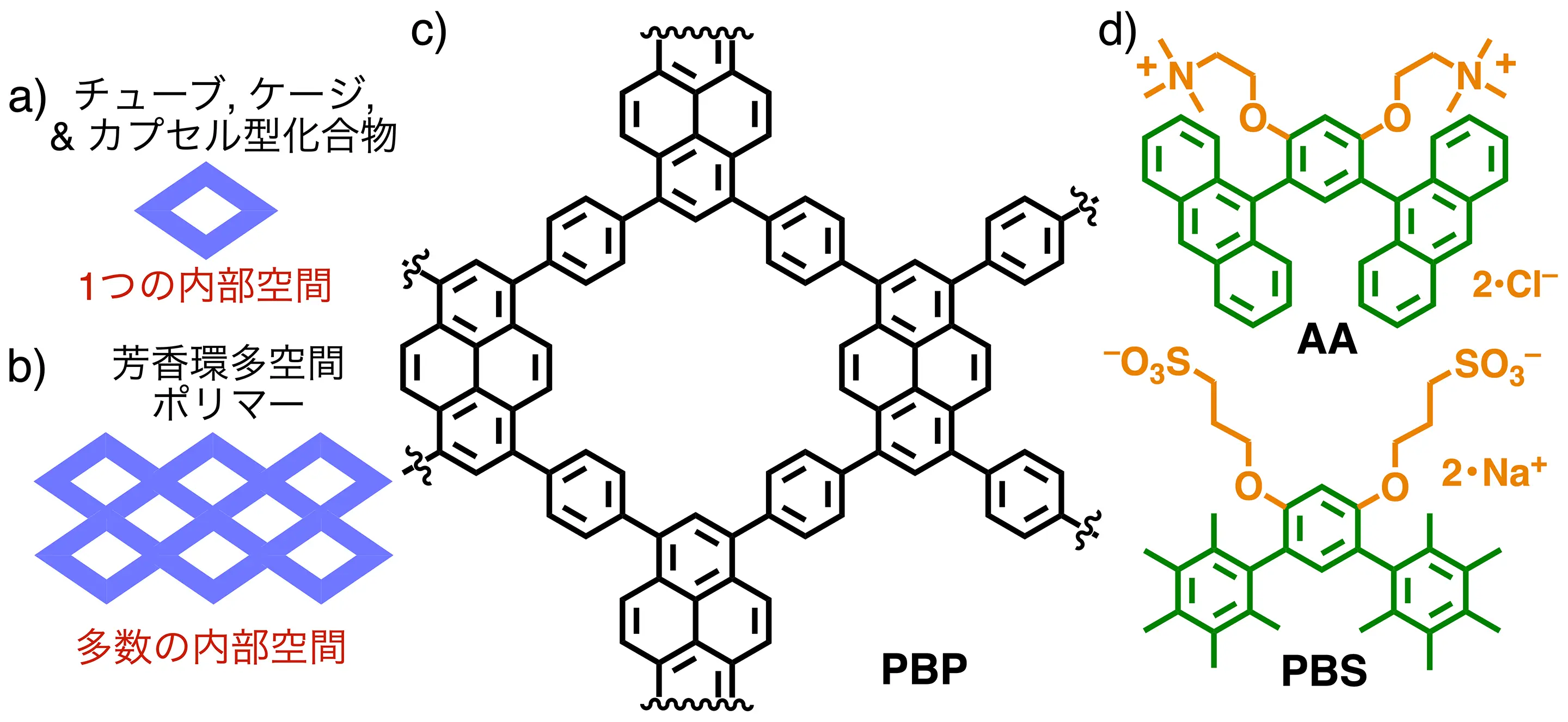 図1. a)一つの空間を持つ可溶性の化合物とb)芳香環多空間を持つ不溶性のポリマーの模式図、c)球状の芳香環多空間ポリマーの基本骨格、 d)湾曲型両親媒性分子。
<関連情報>
- https://www.isct.ac.jp/ja/news/2mhw9tbqni1m#top
- https://www.isct.ac.jp/plugins/cms/component_download_file.php?type=2&pageId=&contentsId=1&contentsDataId=1763&prevId=&key=3c5eab6e1eb4980c10b82464d3267a41.pdf
- https://www.cell.com/chem/fulltext/S2451-9294(25)00206-2
芳香族ミセル内の多孔性芳香族ポリマーからなる水性ポリキャビティホスト Aqueous polycavity hosts composed of porous aromatic polymers within aromatic micelles
Shinji Aoyama ∙ Lorenzo Catti ∙ Michito Yoshizawa
Chem Published:June 2, 2025
DOI:https://doi.org/10.1016/j.chempr.2025.102616
The bigger picture
Porous aromatic/polyaromatic polymers (PAPs) are appealing polycavity materials, yet their applications have been limited to the solid state as mixtures due to complete insolubility. To unlock their microporous functions in solution, we here report the efficient solubilization of PAPs, with ∼100 nm dimensions, through encapsulation by aromatic micelles in water. This method enables straightforward size fractionation of the polymers via a centrifugation-filtration protocol, yielding highly monodisperse particles. Importantly, the resultant composites act as aqueous, giant polycavity hosts that incorporate hydrocarbons and fluorescent dyes, providing unique quaternary host-guest composites. The obtained composites display dye-based emission, enhanced through the co-incorporation in water. This versatile strategy will also be applicable to inorganic and organic-inorganic porous solids, paving the way for superior host-guest composites tailored for storage, sensing, and catalytic applications in water.
Highlights
- Preparation of aqueous polycavity hosts with ∼100 nm dimensions
- Size fractionation of the giant hosts via a centrifugation-filtration method
- Incorporation of hydrocarbons and/or dyes into the polycavities in water
- Observation of dye-based emission from unusual quaternary composites
Summary
Porous aromatic/polyaromatic polymers (PAPs) have been widely investigated as polycavity materials, featuring infinite grid frameworks with high stability. However, in contrast to host-guest functions in mono/oligocavities, the applications of these polycavities remained largely limited, owing to the complete insolubility, ill-defined structures, and inseparability. Here, we report a general strategy for the facile preparation of aqueous polycavity hosts through uptake of insoluble PAPs within aromatic micelles in water. The obtained aqueous host-guest composites, e.g., including a pyrene-benzene-based PAP, are analyzed via solution/solid-state techniques, revealing roughly spherical ∼100 nm-sized particles. The giant composites can be easily size fractionated in a highly monodisperse fashion using a centrifugation-filtration protocol. Importantly, the water-soluble polycavities of the PAPs within the micelle provide cavity-dependent incorporation abilities toward hydrocarbons, accompanying large emission enhancement (up to ∼9-fold) of the semi-rigid polycavities. Medium-sized dyes and hydrocarbons are furthermore co-incorporated into the polycavities, yielding unusual quaternary host-guest composites with enhanced dye-based emission.