2026-11-16 オックスフォード大学
<関連情報>
- https://www.ox.ac.uk/news/2026-11-13-exciting-new-discoveries-from-the-euclid-satellites-first-major-data-release
- https://arxiv.org/abs/2611.16504
Euclid:データリリース1(DR1)―初のNISP輝線マップ:銀河進化研究に向けた手法、検証および応用(Euclid: Data Release 1 (DR1) – First NISP emission-line maps: Methodology, validation, and applications to galaxy evolution)
L. Gabarra, B. R. Granett, C. Mancini, G. Dalton, A. Henderson de la Fuente, F. Rigamonti, S. Quai, F. Ricci, E. Daddi, M. Talia, M. Fumagalli, M. Bolzonella, A. Feltre, J. Matharu, T. Harvey, D. Scott, G. Zamorani, L. Pozzetti, P. Cassata, G. Rodighiero, F. Cogato, E. Medinaceli, I. Lewis, E. Schallig, R. G. Varadaraj, A. Iovino, A. Mercurio, M. Longhetti, F. Shankar, B. Altieri, S. Andreon, N. Auricchio, C. Baccigalupi, M. Baldi, A. Balestra, S. Bardelli, P. Battaglia, A. Biviano, E. Branchini, M. Brescia, J. Brinchmann, S. Camera, V. Capobianco, C. Carbone, J. Carretero, M. Castellano, G. Castignani, S. Cavuoti, P.-Y. Chabaud, K. C. Chambers, A. Cimatti, C. Colodro-Conde, G. Congedo, C. J. Conselice, L. Conversi, Y. Copin, A. Costille, F. Courbin, H. M. Courtois, M. Cropper, H. Degaudenzi, S. de la Torre, G. De Lucia, H. Dole, F. Dubath, X. Dupac, S. Escoffier, M. Fabricius, M. Farina, R. Farinelli, F. Faustini, S. Ferriol, F. Finelli, P. Fosalba, N. Fourmanoit, M. Frailis, E. Franceschi, M. Fumana, S. Galeotta, K. George, W. Gillard, C. Giocoli, P. Gómez-Alvarez, J. Gracia-Carpio, A. Grazian, F. Grupp, L. Guzzo, W. G. Hartley, S. V. H. Haugan, S. Hemmati, H. Hoekstra, W. Holmes, I. M. Hook, F. Hormuth, A. Hornstrup, M. Huertas-Company, K. Jahnke, M. Jhabvala, S. Kermiche, A. Kiessling, B. Kubik, M. Kümmel, M. Kunz, H. Kurki-Suonio, A. M. C. Le Brun, V. Le Brun, D. Le Mignant, P. Liebing, S. Ligori, P. B. Lilje, V. Lindholm, I. Lloro, M. Magliocchetti, G. Mainetti, O. Mansutti, S. Marcin, O. Marggraf, M. Martinelli, N. Martinet, F. Marulli, R. J. Massey, S. Mei, M. Meneghetti, E. Merlin, G. Meylan, P. Monaco, A. Mora, M. Moresco, C. Moretti, L. Moscardini, R. Nakajima, C. Neissner, S.-M. Niemi, C. Padilla, S. Paltani, F. Pasian, W. J. Percival, V. Pettorino, A. Pezzotta, G. Polenta, M. Poncet, L. A. Popa, F. Raison, A. Renzi, J. Rhodes, G. Riccio, I. Risso, F. Rizzo, E. Romelli, M. Roncarelli, B. Rusholme, R. Saglia, Z. Sakr, D. Sapone, B. Sartoris, M. Sauvage, M. Schirmer, P. Schneider, M. Scodeggio, A. Secroun, E. Sihvola, P. Simon, G. Sirri, L. Stanco, C. Surace, P. Tallada-Crespí, A. N. Taylor, H. I. Teplitz, I. Tereno, S. Toft, R. Toledo-Moreo, F. Torradeflot, I. Tutusaus, J. Valiviita, T. Vassallo, D. Vibert, Y. Wang, J. Weller, A. Zacchei, F. M. Zerbi, I. A. Zinchenko, E. Zucca, P. Bergamini, J. García-Bellido, C. M. Gutierrez, K. Tanidis, and 87 additional authors.Euclid Consortium
Astrophysics of Galaxies(astro-ph.GA)2026-11-12
DOI:10.48550/arXiv.2611.16504

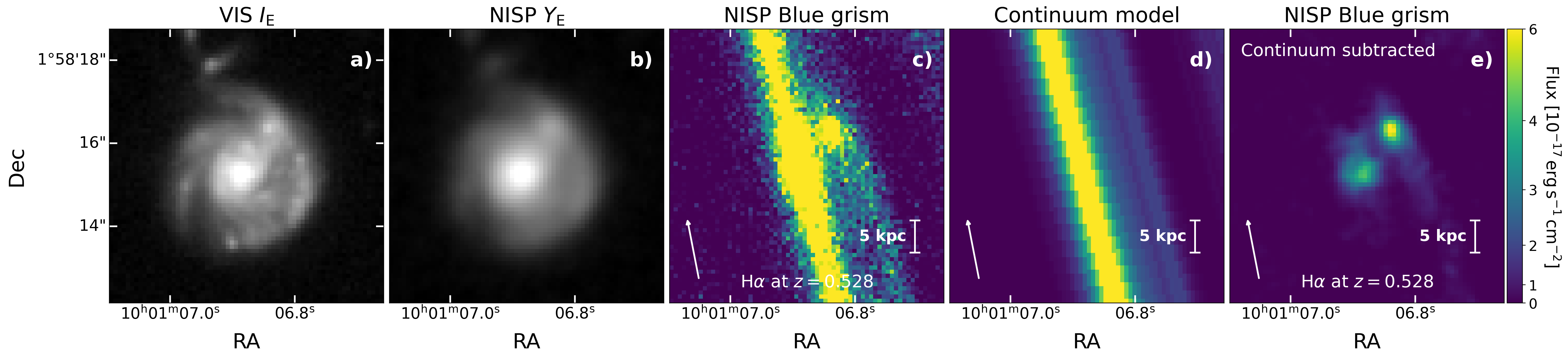
Figure 1:Construction of an Hα emission-line map for a face-on spiral galaxy at z=0.528 using 116 co-added blue-grism exposures. (a) IE image. (b) YE image. (c) Hα map before continuum subtraction. (d) Model of the stellar continuum. (e) Continuum-subtracted and smoothed Hα map. The arrows indicate the grism dispersion direction, and the vertical bars correspond to a physical scale of 5kpc. Creative Commons CC0 1.0 Universal
欧州宇宙機関(ESA)の宇宙望遠鏡Euclidに搭載された近赤外線分光光度計NISPを利用し、銀河から放射される輝線の空間分布を二次元画像として再構築する手法を開発した研究である。従来の一次元分光解析では失われてしまう銀河内部の位置情報を保持し、星形成領域の分布や内部運動を調べることを目的としている。研究では、2023年11月にCOSMOS領域で取得されたEuclidの性能検証観測データを使用し、GELSAと呼ばれる解析ソフトウェアによって、NISPのスリットレス分光データからHαなどの輝線マップを作成した。赤方偏移0.4~0.9の銀河を対象とし、885個の銀河についてHαと[N II]輝線を分離して質量・金属量関係を再構築したほか、2,634個の銀河のHα放射の動径分布を統計的に解析した。その結果、従来の一次元分光測定と整合する質量・金属量関係が得られ、Hα放射は恒星連続光よりもやや広い範囲に分布することが示された。本手法は、銀河内部の星形成領域の検出、速度勾配の評価、銀河進化の空間分解研究に新たな観測手段を提供する。ただし、現段階では観測領域が限定され、分散方向の異なる複数観測を統合した解析や近接天体のスペクトル汚染への対応が今後の課題である。
arXiv+1
5. English
This study develops a methodology for reconstructing two-dimensional emission-line maps from observations obtained with the Near-Infrared Spectrometer and Photometer (NISP) aboard the European Space Agency’s Euclid space telescope. Unlike conventional one-dimensional spectroscopic extraction, the proposed approach preserves spatial information within galaxies, enabling investigations of star-forming regions and internal kinematics. The researchers used Euclid performance-verification observations of the COSMOS field acquired in November 2023 and developed an analysis pipeline called GELSA to generate emission-line maps, including Hα, from slitless spectroscopic data. The analysis focused on galaxies at redshifts of 0.4–0.9. Using these maps, the researchers reconstructed the galaxy mass–metallicity relation for 885 galaxies by separating the Hα and [N II] emission lines and statistically analysed the radial Hα emission profiles of 2,634 galaxies. The resulting mass–metallicity relation was consistent with conventional one-dimensional spectroscopic measurements, while the Hα emission was found to extend modestly beyond the stellar continuum. The methodology provides a new observational tool for identifying star-forming regions, investigating projected internal velocity gradients, and conducting spatially resolved studies of galaxy evolution. Current limitations include the restricted observational field, the use of a single dispersion orientation, and potential contamination from overlapping spectra of neighbouring sources.
原論文:arXiv公式ページ