2026-11-05 中国科学院(CAS)
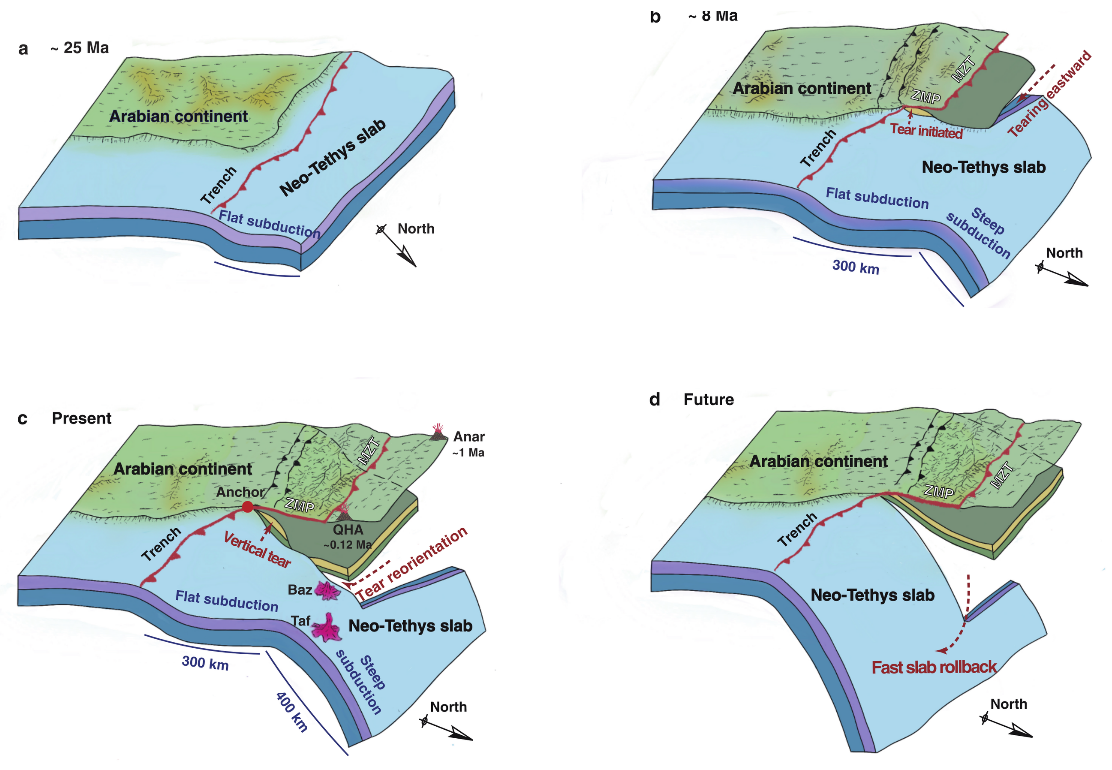
Evolutionary model of double slab tearing during the Neo-Tethyan subduction–collision transition. Panels (a–d) illustrate the proposed scenarios at approximately 25 Ma, 8 Ma, the present day, and a possible future stage, respectively. (Image by CHEN’s group)
<関連情報>
- https://english.cas.cn/newsroom/research-news/202611/t20261105_1213293.shtml
- https://www.nature.com/articles/s41561-026-02129-4
新テチス海沈み込み・衝突遷移域における二重スラブ断裂の地震学的証拠 Seismic evidence for double slab tears at the Neo-Tethyan subduction–collision transition
Haiqiang Lan, Gaoshan Guo, Ling Chen, Morteza Talebian, Lingkai Meng, Xiaofeng Liang, Bo Wan, Yang Chu, Yaguang Chen, Sebastien Chevrot, Jianfeng Yang, Frederic Mouthereau, Yifan Gao, Zimu Wu, Xu Wang, Naeim Mousavi & Jimin Sun
Nature Geoscience Published:04 November 2026
DOI:https://doi.org/10.1038/s41561-026-02129-4
Abstract
The transition from oceanic subduction to continental collision is a key stage in the Wilson Cycle. Yet, key processes governing this transition remain unclear owing to sparse observations of structure at depth. One such process is detachment of the subducting slab, which influences both deformation and magmatism in the overriding plate. Here we present seismic tomographic images that we interpret as evidence for two slab tears beneath southeastern Iran, where the Neo-Tethys Ocean is closing. Specifically, we show that in the Makran subduction zone, the oceanic lithosphere has continuously subducted to depths of at least 450 km, whereas in the Zagros collision zone to the west, the continental lithosphere has subducted no deeper than 300 km, resulting in east–southward slab tearing and detachment. We further identify another slab tear that probably initiated at the junction between the Makran Trench and the transform boundary and has propagated southward as the continental plate advances northward. The coexistence of these two tearing modes provides a rare snapshot of the short-lived early transition from oceanic subduction to continental collision.