2026-04-10 中国科学院(CAS)
<関連情報>
- https://english.cas.cn/newsroom/research-news/202604/t20260408_1155385.shtml
- https://www.science.org/doi/10.1126/science.ady2027
イエローストーンの岩石圏を貫通するマグマ供給システムの地殻構造起源 Tectonic origin of Yellowstone’s translithospheric magma plumbing system
Zebin Cao, Lijun Liu, Bo Wan, Ling Chen, and Craig Lundstrom
Science Published:9 Apr 2026
DOI:https://doi.org/10.1126/science.ady2027
Editor’s summary
The Yellowstone caldera is known for a pattern of bimodal super-eruptions, the most recent occurring 630,000 years ago. Less known is the source of these eruptions, with ideas ranging from a deep mantle plume to a shallower, mixed mantle-crustal magma source. Cao et al. ran a three-dimensional regional model based on geophysical observations, unifying mantle and crustal dynamics to reproduce present-day topography, stress, and seismic patterns (see the Perspective by Farrell). Their models support a mostly upper-mantle source of primary melts. This source feeds a tectonically extending zone from which magmas can be periodically injected into a shallow, evolving reservoir below Yellowstone. —Angela Hessler
Structured Abstract
INTRODUCTION
Explosive silicic volcanism represents one of Earth’s most catastrophic geological hazards, having widespread environmental impacts, including climate disruption and mass extinction events. A large caldera-forming eruption is the ultimate surface manifestation of complex dynamic processes occurring in the underground magmatic system. Thus, understanding the mechanisms of subsurface magma migration and evolution is crucial for eruption forecasting and volcanic hazard assessments.
The Yellowstone volcanic system, located in the tectonically active western United States, has fueled several of the largest caldera-forming events in the past 2.1 million years. Therefore, its next eruption may also cause severe consequences and major societal impacts. Numerous studies have been devoted to understanding the physical state of Yellowstone’s subsurface magmatic system. However, the driving mechanism for Yellowstone’s volcanism remains debated, owing to both the complex tectonic history of western North America and the elusive underlying mantle dynamics.
RATIONALE
It is generally believed that large silicic calderas with repeated eruptions, such as Yellowstone, have their shallow magmatic reservoirs recharged by melts from the underlying asthenosphere. With long-term melt accumulation, the shallow magma reservoirs transition to an eruptible state. After a caldera-forming eruption, a new cycle starts.
Recent geophysical studies show that Yellowstone’s shallow magma reservoirs are replenished by melts from the asthenosphere. Both seismic and magnetotelluric images reveal that the Yellowstone caldera complex and magma reservoirs are connected by a southwest-dipping plumbing network that extends to the uppermost asthenosphere beneath the eastern Snake River Plain, where hot asthenosphere partially melts. This tilted translithospheric magma plumbing system (TLMPS) is a robust feature of different observational studies, but its geodynamic origin remains unknown.
RESULTS
To identify the driving mechanism of Yellowstone’s tilted TLMPS and the origin of melts, we constructed a comprehensive three-dimensional geodynamic model using geophysically and geodynamically constrained present-day structures of the convective mantle and the continental lithosphere. In this model, we simultaneously calculated the present-day dynamics of the lithosphere and the convective mantle in a unified physical framework.
Our results show that Yellowstone’s tilted TLMPS is primarily controlled by lithospheric tectonics. Below Yellowstone, our model predicts a southwest-dipping extension zone, jointly shaped by the lithospheric body force due to lithospheric density structure and basal traction caused by eastward-flowing hot asthenosphere interacting with the lithosphere. This tilted translithospheric deforming zone closely resembles the geophysically imaged TLMPS beneath Yellowstone, confirming the key role of tectonic extension in tapping melts from the uppermost asthenosphere and bringing them to the surface.
By combining our modeling results with multidisciplinary observations, we further demonstrate that most of Yellowstone’s magma originates from the shallow asthenosphere with little input from the deep plume, migrates through the tectonically controlled TLMPS, and evolves in the crustal mushes to eventually drive volcanism on the surface.
CONCLUSION
TLMPSs with complex geometries, as confirmed in Yellowstone, have also been identified in other regions of the world under various tectonic settings. These other magmatic systems may also be shaped by shallow lithospheric tectonics similar to Yellowstone’s. Therefore, our inferred dynamics for the Yellowstone volcanic system could be representative of large silicic calderas worldwide and provide insights for eruption forecasting and volcanic hazard assessments.
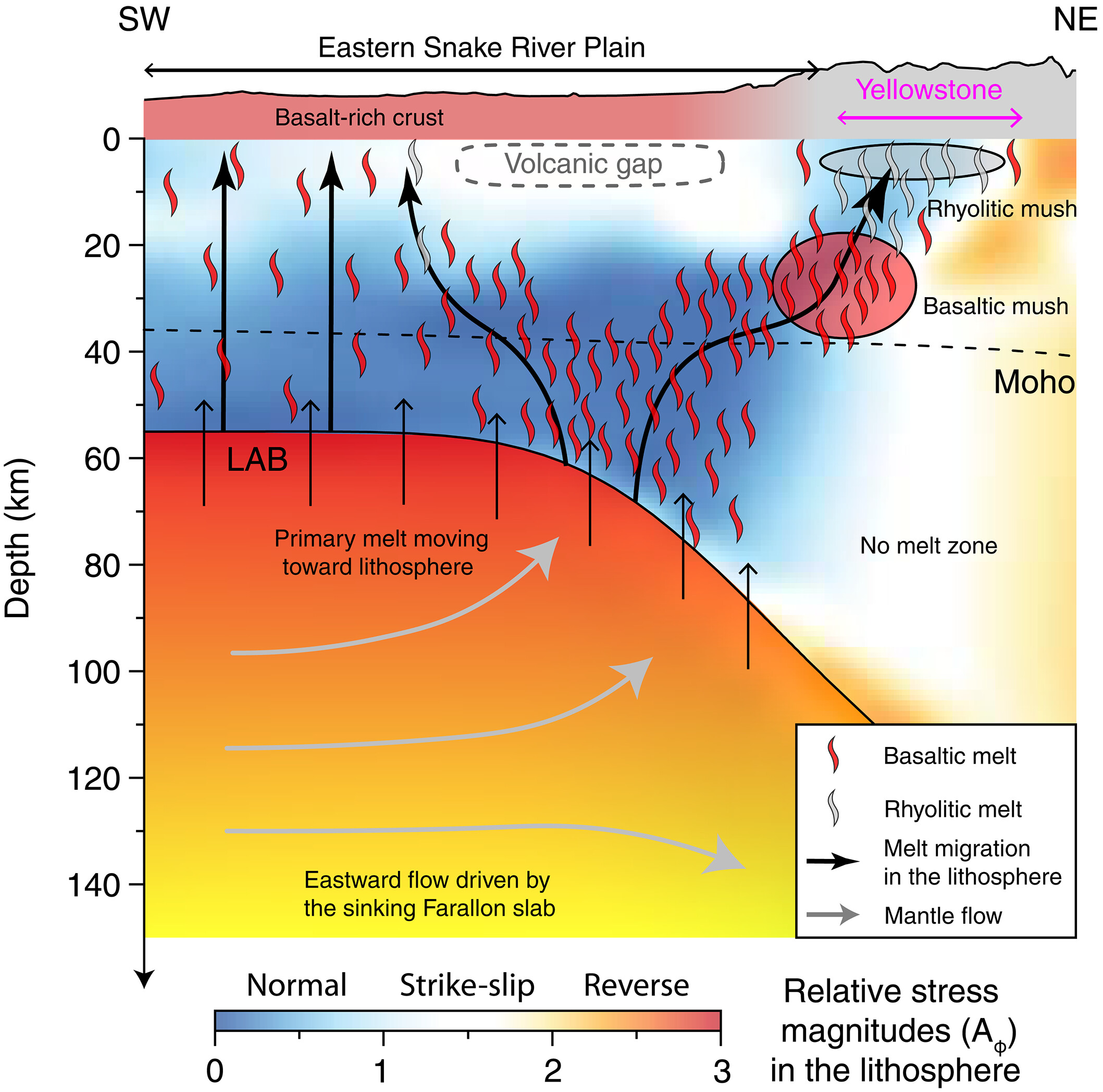
Cartoon showing Yellowstone’s present-day translithospheric magma plumbing system (TLMPS).
The blue region in the lithosphere, representing the tectonic extensional region, generally outlines the TLMPS in the Yellowstone region. In the asthenosphere beneath Yellowstone, eastward-flowing hot material produces primary melts with little input from the mantle plume. After penetrating into the lithosphere, primary melts migrate into the tilted TLMPS and ultimately fuel Yellowstone’s surface volcanism. LAB, lithosphere-asthenosphere boundary.
Abstract
Yellowstone is widely recognized for its crustal magma reservoirs replenished by asthenospheric melts. However, how primary melts traverse the rigid lithosphere and evolve into bimodal volcanism remains unclear. By leveraging multidisciplinary observations and a data-oriented geodynamic modeling approach, we demonstrate that magma generation and migration in the Yellowstone region are primarily governed by lithospheric tectonics, with negligible contribution from the mantle plume. Below Yellowstone, our model predicts a southwest-dipping extension zone, shaped jointly by the lithospheric body force and basal traction. This tilted translithospheric deforming zone resembles the geophysically imaged magma plumbing system, confirming the key role of tectonic extension in tapping asthenospheric melts to shallow depths. Furthermore, we suggest that the translithospheric magma plumbing system facilitates complex magmatic processes, ultimately driving surface bimodal volcanism.