
2026-03-23 合肥物質科学研究院(HFIPS)
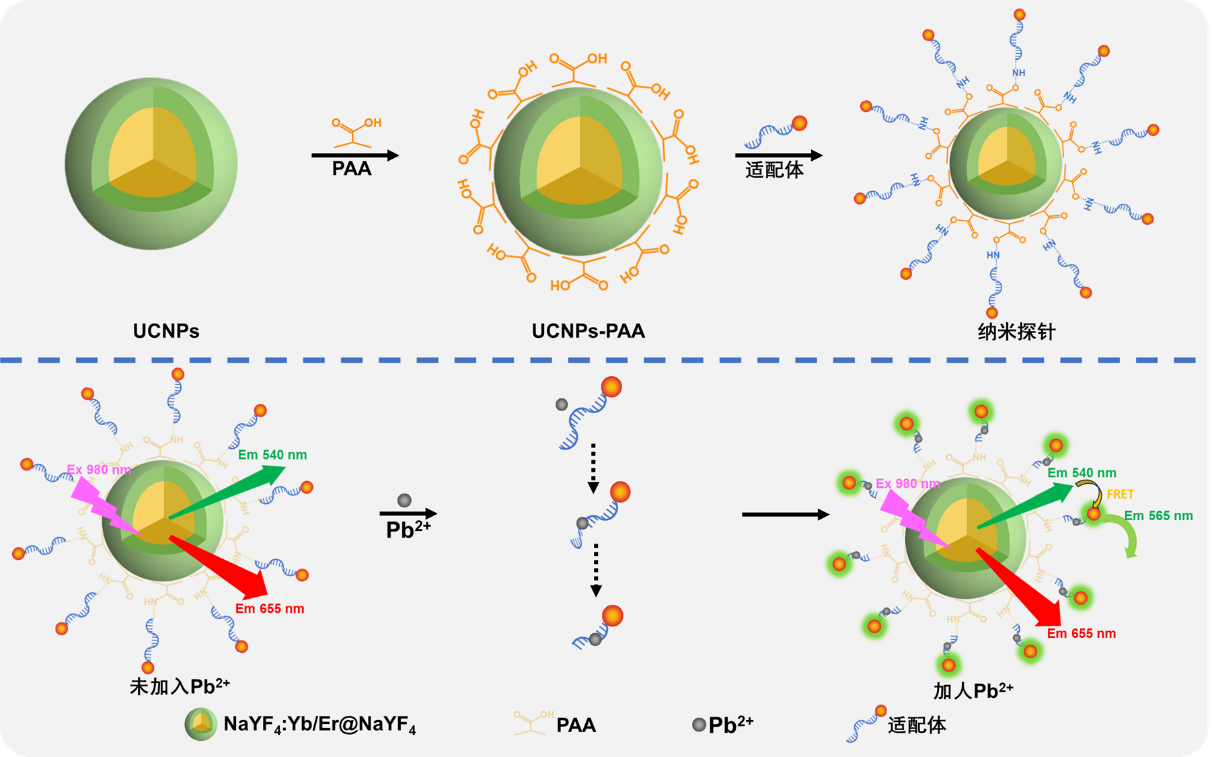
Schematic Illustration of the Design of Reverse Dual‑Signal Upconversion Nanoprobe and Its Sensing Mechanism for Pb²⁺ Detection. (Image by YANG Fan)
<関連情報>
- https://english.hf.cas.cn/nr/bth/202603/t20260323_1153172.html
- https://pubs.acs.org/doi/abs/10.1021/acs.analchem.5c07885
アプタマーを介したエネルギー受容体感作戦略による逆方向の二重信号変化を利用した高コントラストアップコンバージョンナノプローブの構築 Aptamer-Mediated Energy Acceptor Sensitization Strategy Driving Reverse Dual-Signal Change for Constructing High-Contrast Upconversion Nanoprobes
Wei Jia,Xiaohui Kang,Zhenzhen Xie,Bo Liang,Fan Yang,and Changlong Jiang
Analytical Chemistry Published: March 4, 2026
DOI:https://doi.org/10.1021/acs.analchem.5c07885
Abstract
Upconversion nanoprobes show great potential in sensing applications due to low background interference and near-infrared excitation. Most upconversion nanoprobes are constructed based on the principle of luminescence resonance energy transfer, with only a single sensing signal. However, due to the structural characteristics of upconversion nanoparticles (UCNPs), the LRET efficiency is limited, which severely reduces the signal contrast and becomes a critical bottleneck for improving the sensitivity. This study proposes an aptamer-mediated energy acceptor sensitization strategy to realize the reverse dual-signal change for the construction of a highly sensitive upconversion nanoprobe with high signal contrast. Specifically, the probe is fabricated by conjugating a Cy3 dye-labeled aptamer to the surface of UCNPs. As a proof of concept, the nanoprobe is further applied for the detection of Pb2+, whose trace concentration in soil or agricultural products would cause irreversible harm in the human body. In the presence of Pb2+, the aptamer undergoes a structural transition into a G-quadruplex, which shortens the distance between Cy3 and UCNPs and activates the LRET process from UCNPs to the Cy3 dye. As a result, the green upconversion luminescence at 540 nm is quenched while Cy3 fluorescence at 565 nm is sensitized, enabling reverse sensing signal changes. Using the I540/I565 ratio as the detection signal, the nanoprobe achieves a detection limit as low as 51 pM, exhibiting high selectivity and anti-interference capability and demonstrating excellent performance in complex samples. This work proposes a versatile strategy to overcome the signal contrast limitations of conventional upconversion nanoprobes.

