2026-02-17 ラトガース大学
<関連情報>
- https://www.rutgers.edu/news/scientists-prove-shellfish-can-be-farmed-far-shore
- https://academic.oup.com/naja/advance-article/doi/10.1093/naaqua/vraf038/8475327
大西洋アサリSpisula solidissima の沖合養殖:成長、生存および実現可能性 Offshore aquaculture of Atlantic surfclams Spisula solidissima: Growth, survival and feasibility
Laura Steeves ,Sarah Borsetti ,Rachel Davitt ,Daphne Munroe
North American Journal of Aquaculture Published:12 February 2026
DOI:https://doi.org/10.1093/naaqua/vraf038
ABSTRACT
Objective
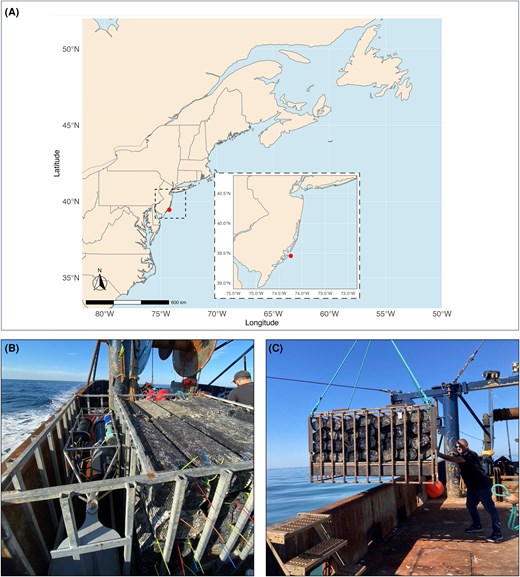
The Atlantic surfclam Spisula solidissima is a commercially valuable bivalve in the mid-Atlantic region of the United States. Although surfclam aquaculture is not yet widely practiced, it offers an opportunity to diversify surfclam products and expand production beyond traditional wild harvest methods. Although aquaculture farms are typically in protected coastal areas, farming surfclams in the open ocean offers the advantages of less competition for space, higher water quality, and natural habitat for the species. This study evaluates the feasibility of cultivating surfclams in federal waters offshore of New Jersey, USA.
Methods
Two experimental deployments were conducted in fall 2023 and spring 2024 of over 300,000 hatchery-reared seed-sized (15-mm shell length) surfclams. In cooperation with commercial partners, surfclams were deployed in large steel cages and contained within plastic mesh Hexcyls, often used on oyster longline farms. To determine the effects of stocking density on growth, surfclams were stocked at three densities ranging from 266 to 1,995 surfclams per Hexcyl in the fall and from 118 to 880 surfclams per Hexcyl in the spring.
Results
Growth rates (0.001–0.06 mm/day) that are comparable to those reported for wild populations in combination with high survival (≈50% fall and 100% for fall and spring deployments, respectively) indicate that offshore aquaculture may be a viable method for commercial surfclam production, particularly for growing littleneck-sized surfclams (25–50-mm shell length).
Conclusions
Findings from this collaborative effort offer insight into the potential for offshore surfclam aquaculture using new grow-out areas with environmental conditions that are similar to those of the species’ natural habitats.