2026-02-17 ハーバード大学
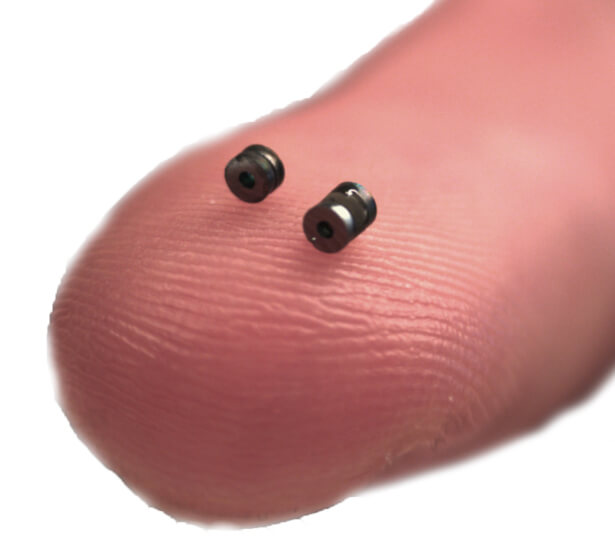
Microcavities of two different lengths, 45 microns and 1 millimeter, placed on a finger tip.
<関連情報>
- https://seas.harvard.edu/news/microscopic-mirrors-future-quantum-networks
- https://opg.optica.org/optica/fulltext.cfm?uri=optica-13-2-313
高フィネス座屈マイクロキャビティ High finesse buckled microcavities
S. W. Ding, B. Grinkemeyer, G. E. Mandopoulou, R. Jiang, A. S. Zibrov, G. Huang, K. Yang, M. D. Lukin, and M. Lončar
Optica Published: February 11, 2026
DOI:https://doi.org/10.1364/OPTICA.582994
Abstract
Optical cavities are widely used in modern science and technology to enable a wide range of both quantum and classical applications. Recently, the growing demand for miniaturization and high performance has fueled the exploration of new fabrication methods beyond traditional polishing techniques and macroscopic mirrors. Visible and near-infrared (NIR) wavelengths are particularly important for quantum applications, where achieving low-loss resonators is also more challenging than in the telecom range, presenting unique challenges and opportunities for microscopic cavity systems. Here, we present a fabrication method for making NIR microcavities using buckled dielectric membrane mirrors, achieving a record finesse of 0.9 million at 780 nm for microcavities. We demonstrated flexible device geometries—including singular mirrors and mirror arrays, featuring radii of curvature ranging from 1 to 10 mm. The fabrication process offers high uniformity, high yield, and robust performance across a wide range of cavity lengths. Additionally, we can produce easy-to-assemble microcavity packages, with a total volume of ~2(4)mm3, featuring optical modes with a linewidth of 5.16 MHz (570 kHz) and a free spectral range (FSR) of 3.18 THz (150 GHz). Our results extend the frontier of microcavity fabrication for classical and quantum photonic technologies.