2026-02-16 ノースカロライナ州立大学(NC State)
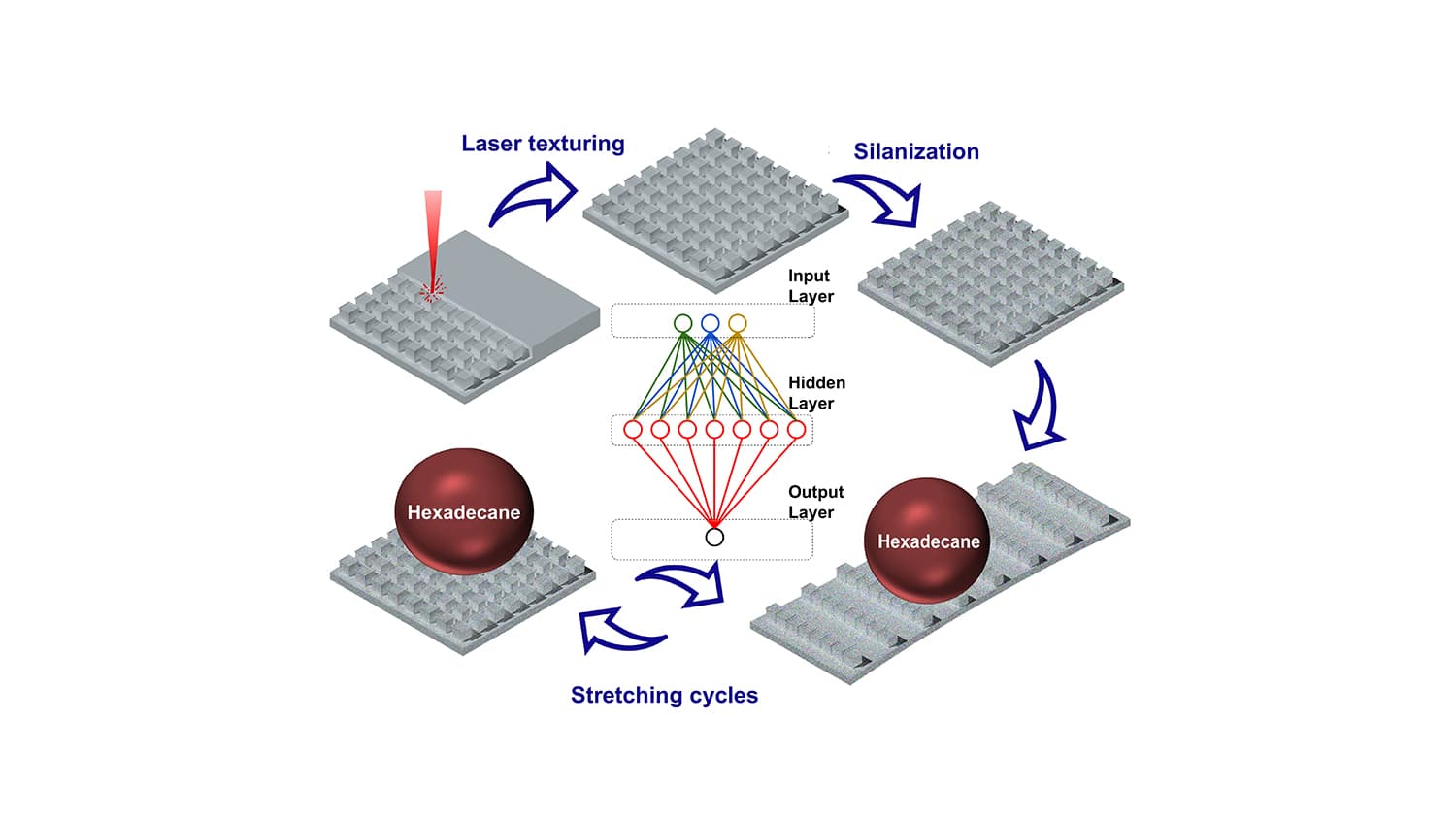
Schematic of fabrication steps, structure and and hexadecane repellency during stretch-release cycles.
<関連情報>
- https://news.ncsu.edu/2026/02/researchers-create-ultra-stretchable-liquid-repellent-materials-via-laser-ablation/
- https://www.cell.com/matter/abstract/S2590-2385(25)00653-8
機械学習誘導レーザーアブレーションによる超伸縮性超疎水性表面 Ultra-stretchable superomniphobic surfaces via machine-learning-guided laser ablation
Mohammad Javad Zarei ∙ Sreekiran Pillai ∙ Adil M. Rather ∙ Mohammed S. Barrubeeah ∙ Tarek Echekki ∙ Arun K. Kota
Matter Published:February 16, 2026
DOI:https://doi.org/10.1016/j.matt.2025.102610
Progress and potential
Superomniphobic surfaces are extremely repellent to virtually all liquids. While there are many superomniphobic surfaces, there are very few highly stretchable superomniphobic surfaces. In this work, we developed ultra-stretchable superomniphobic surfaces using a solvent-free CO2 laser ablation technique. Due to the highly complex nature of laser-material interactions, identifying the optimal laser ablation conditions to develop ultra-stretchable superomniphobic surfaces is a very tedious process. To overcome this challenge, we developed a machine learning framework that rapidly identifies the optimal laser ablation conditions without extensive trial-and-error experimentation. Using this machine-learning-guided laser ablation, we developed surfaces that maintain superomniphobicity upon stretching, bending, and twisting for thousands of cycles. We envision that our machine-learning-guided laser ablation will inspire and enable rapid discovery of innovative stretchable surfaces, with applications in artificial skins, soft robotics, flexible protective coatings, and wearable electronics.
Highlights
- Solvent-free CO2 laser ablation for ultra-stretchable superomniphobic surfaces
- Machine learning framework for optimal laser ablation parameters
- Surfaces retain superomniphobicity at up to 400% strain and 5,000+ stretch-release cycles
Summary
In this work, we report ultra-stretchable superomniphobic surfaces fabricated using a simple, inexpensive, scalable, and solvent-free CO2 laser ablation. Since the parametric space for laser ablation is multidimensional with millions of combinations, we predicted the optimal laser ablation parameters to achieve superomniphobicity with a machine learning (ML)-based algorithm. Guided by ML, we experimentally achieved ultra-stretchable superomniphobic surfaces, which retained superomniphobicity even at 400% strain and 5,000+ stretch-release cycles, as well as under a diverse range of deformations. Furthermore, through systematic experiments and theoretical analysis, we studied the influence of elongation on contact angles, breakthrough pressures, and sliding angles on our ultra-stretchable superomniphobic surfaces. We envision that our innovative ML-guided laser ablation protocol to fabricate ultra-stretchable superomniphobic surfaces will pave the way to developing novel and scalable artificial skins, textile dressings, and stretchable electronics.
微小突起誘起応力再分配による 超弾性超疎水性表面 Hyperelastic superomniphobic surfaces via microprotrusion-induced stress redistribution
Mohammad Javad Zarei,Sreekiran Pillai,Omar Eldaly,Adil Majeed Rather,Sravanthi Vallabhuneni,Mohammed A. Zikry and Arun Kumar Kota
Materials Horizons Published:01 Aug 2025
DOI:https://doi.org/10.1039/D5MH01250C
Abstract
In this work, we report hyperelastic superomniphobic surfaces that have been engineered to retain superomniphobicity, without coating delamination, even at 400% strain and after thousands of stretch–release cycles. To achieve such hyperelastic superomniphobic surfaces, we introduce a novel design – an array of discrete microprotrusions on the hyperelastic material that redistribute the stresses out-of-plane during elongation. Such an out-of-plane redistribution of stresses results in nearly stress-free tops of the microprotrusions, allowing the coating to be virtually intact even after 5000 stretch–release cycles. Furthermore, through systematic experiments and theoretical analysis, we studied the influence of elongation on contact angles, sliding angles and breakthrough pressures on our hyperelastic superomniphobic surfaces. We envision that our robust hyperelastic superomniphobic surfaces will have a wide range of applications in wearable electronics, textiles, artificial skins, droplet manipulation and protective wraps.