2026-02-16 京都大学
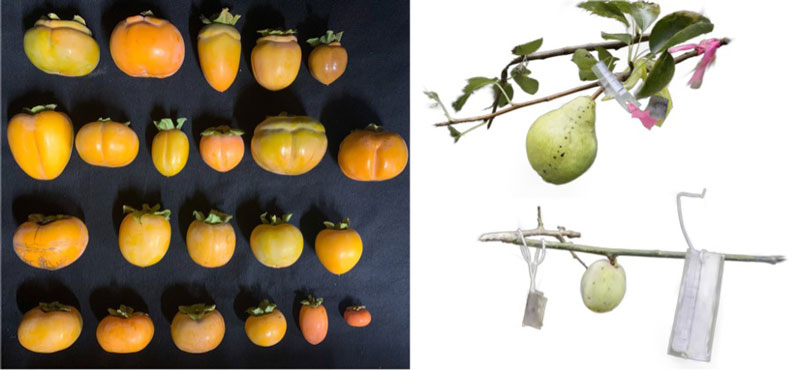
左)京都大学附属農場・京都農場に保存されている多様な形状のカキ(写真提供:久住あかね)、(右)3D Gaussian Splattingによりモデル化したバラ科果樹(写真提供:新保彩萌)
<関連情報>
- https://www.kyoto-u.ac.jp/ja/research-news/2026-02-16
- https://www.kyoto-u.ac.jp/sites/default/files/2026-02/web_2602_Nishiyama-292a3a8f7ed4857b9c26332a26ab8920.pdf
- https://www.sciencedirect.com/science/article/pii/S2643651526000038
3D Gaussian Splatting を用いたバラ科仁果および核果における果実成長動態の空間解析 Spatially resolved analysis of growth dynamics in pome and drupe fruits of Rosaceae using 3D Gaussian Splatting
Ayame Shimbo, Soichiro Nishiyama, Akane Kusumi, Takuya Morimoto, Hisayo Yamane, Akihiro Itai, Ryutaro Tao
Plant Phenomics Available online: 9 January 2026
DOI:https://doi.org/10.1016/j.plaphe.2026.100166
Abstract
Fruit growth has long been described using single- or double-sigmoid curves; however, these temporal models cannot fully capture the spatial heterogeneity that ultimately shapes a fruit. Here, we present a three-dimensional analysis pipeline that non-destructively tracks spatial fruit growth dynamics from field-collected imagery. Surface landmarks were drawn, and video recordings were taken throughout development for three pome fruits, apple (Malus × domestica), Japanese pear (Pyrus pyrifolia) and European pear (Pyrus communis), and two drupe fruits, peach (Prunus persica) and Japanese apricot (Prunus mume), to track their motion. Using 3D Gaussian splatting, we successfully reconstructed 3D models of the fruits, and the landmark displacement could be measured with high accuracy, with R2 ≥ 0.98 when compared to manual recordings. We found a common spatial growth gradient in the longitudinal growth shared in the pomes and drupes of the Rosaceae; proximal (stem-end) regions exhibited more pronounced growth than the distal (stylar) end. An exception was found in European pear ‘Bartlett,’ which showed relatively vigorous growth in the distal region, explaining its distinct shape with expanded distal end. Transverse expansion varied far less than longitudinal expansion, with a possible association with initial fruit morphology. Inter-fruit growth variability peaked in the fastest-growing regions, particularly in the distal area of the European pear, highlighting the link between growth vigor and phenotypic variance. These results provide foundational insights into the developmental dynamics of both pome and drupe fruits of the Rosaceae family, contributing to the optimization of fruit size, shape, and uniformity.