2026-02-16 東北大学
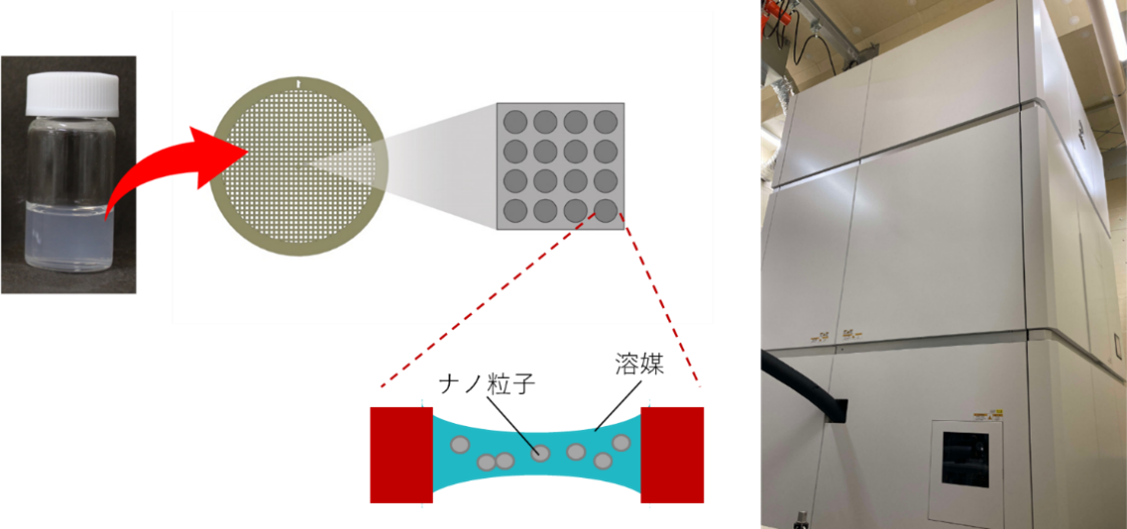
図1. クライオ透過型電子顕微鏡(cryo-TEM)の観察サンプルの模式図(左)と本研究で使用したcryo-TEM装置(CRYO ARM™ 300 II, JEOL ltd.)
<関連情報>
- https://www.tohoku.ac.jp/japanese/2026/02/press20260216-01-cryo.html
- https://www.tohoku.ac.jp/japanese/newimg/pressimg/tohokuuniv-press20260216_01web_Cryo.pdf
- https://pubs.acs.org/doi/10.1021/acsmeasuresciau.5c00158
クライオTEMによる食塩水中のシリカナノ粒子分散状態の直接可視化と定量分析 Direct Visualization and Quantitative Analysis of Silica Nanoparticle Dispersion States in Saline Solution via Cryo-TEM
Masato Iwasawa,Katsuya Miura,Masaya Kashihara,Hirotake Kitagawa,Masashi Ohno,Daisuke Unabara,Tasuku Hamaguchi,and Koji Yonekura
ACS Measurement Science Au Published: February 4, 2026
DOI:https://doi.org/10.1021/acsmeasuresciau.5c00158
Abstract
Quantitative assessment of nanoparticle dispersion in dilute, realistic solvent environments remains a critical challenge for materials intended for use in complex ionic systems, such as carbon dioxide underground and storage (CCS) and enhanced oil recovery (EOR) technologies. While conventional techniques, including dynamic light scattering (DLS) and small-angle X-ray scattering (SAXS), provide valuable ensemble-averaged information, they are particularly limited in dilute systems and lack the spatial resolution required to characterize local dispersion heterogeneities and microscopic agglomeration behavior. Here, we present a quantitative analytical framework that combines cryogenic transmission electron microscopy (cryo-TEM) with AI-integrated automated imaging and Voronoi tessellation analysis to directly visualize and quantify silica nanoparticle dispersion states in saline solutions. Silica nanoparticles functionalized with various organic acids─including malonic, succinic, maleic, DL-malic, and citric acids, as well as L-arabinose─were prepared and examined using cryo-TEM. For each frozen-hydrated sample, several hundred images were acquired under standardized conditions. Automated particle identification and subsequent Voronoi tessellation yielded quantitative dispersion parameters. The coefficient of variation (CV) of Voronoi region areas was introduced as a dimensionless metric to enable intersample comparison. The results revealed distinct dispersion behaviors: samples modified with maleic, DL-malic, and citric acids demonstrated high dispersion stability (CV ≈ 0.4), while unmodified and L-arabinose-modified samples exhibited pronounced agglomeration tendencies (CV ≈ 0.8). Notably, the CV values correlated strongly with DLS-measured particle diameters, further validating the reliability of the proposed methodology. This approach advances the field from qualitative cryo-TEM observation toward quantitative materials characterization, providing mechanistic insights into the effects of surface modification on dispersion stability at the microscopic scale. Furthermore, it offers a robust platform for evaluating nanoparticle behavior under practically relevant solvent conditions.