2026-02-12 ワシントン大学セントルイス校
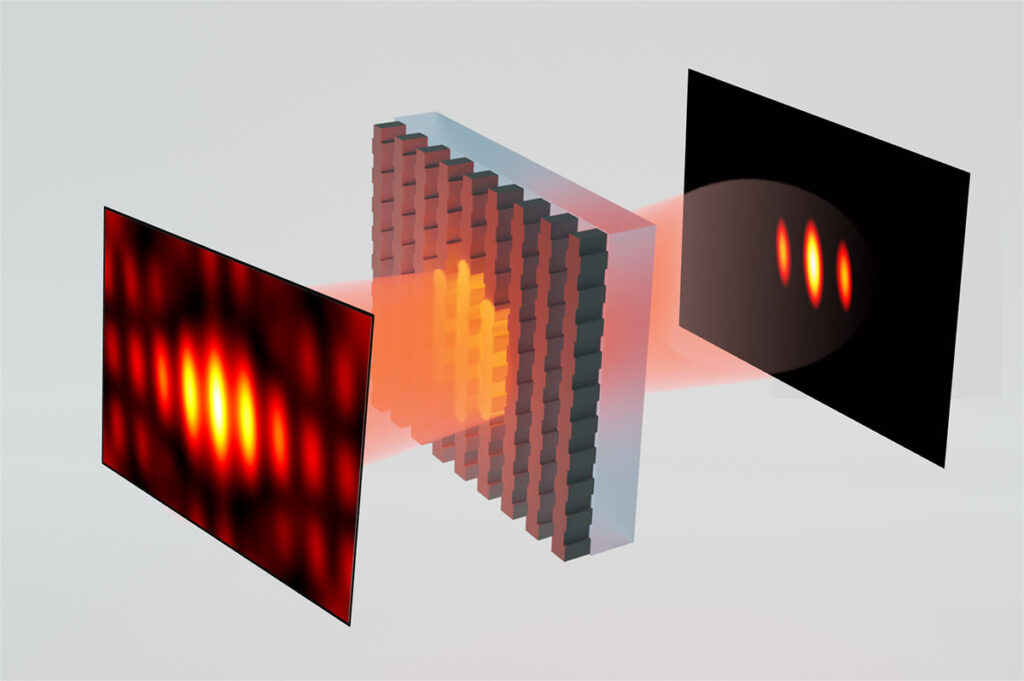
Mark Lawrence’s lab has found a way to improve the efficiency and capability of machine vision and AI diagnostics using optical systems instead of traditional digital algorithms. (Image: Lawrence lab)
<関連情報>
- https://source.washu.edu/2026/02/light-gives-boost-to-image-processing-optical-systems/
- https://engineering.washu.edu/news/2026/Light-gives-boost-to-image-processing-optical-systems.html
- https://pubs.acs.org/doi/10.1021/acs.nanolett.5c05424
パッシブ高品質メタサーフェスを用いた高解像度・超低消費電力の非線形画像処理 High-Resolution and Ultralow-Power Nonlinear Image Processing with Passive High-Quality Factor Metasurfaces
Bo Zhao,Lin Lin,Samuel Ameyaw,Mark Lawrence
Nano Letters Published: January 21, 2026
DOI:https://doi.org/10.1021/acs.nanolett.5c05424
Abstract
Image processing is one of the most exciting domains for applying artificial intelligence but is computationally expensive. Nanostructured metasurfaces have opened the door to the ultimate energy saving by directly processing ambient image data via ultrathin layers before detection. However, a key ingredient of universal computation─nonlinear thresholding functions─have yet to be demonstrated for low intensities without an external power source. Here, we present a passive, all-optical method for nonlinear image processing using silicon nanoantenna arrays. We experimentally demonstrate an intensity thresholding filter capable of processing one-dimensional images with only watt-level power. By leveraging the opto-thermal nonlinearity through high-Q guided mode resonance, we achieve an experimental threshold as low as 0.1 mW/μm2 with a spatial resolution of 1.85 μm. Additional simulations indicate that the threshold can be further reduced while maintaining high spatial selectivity. Analog, pixel-wise, smoothed leaky ReLU activation filters promise to revolutionize image sensing.